Extrusion Line Quotation: What Is Included and What to Check Before You Buy
When buyers compare extrusion line quotations, the first thing they notice is the total price. One supplier is 20% lower. Another is 30% higher. Both claim they are quoting a “complete extrusion line.”
At that point, most teams start negotiating price before they have verified a more basic question: are both suppliers actually quoting the same scope?
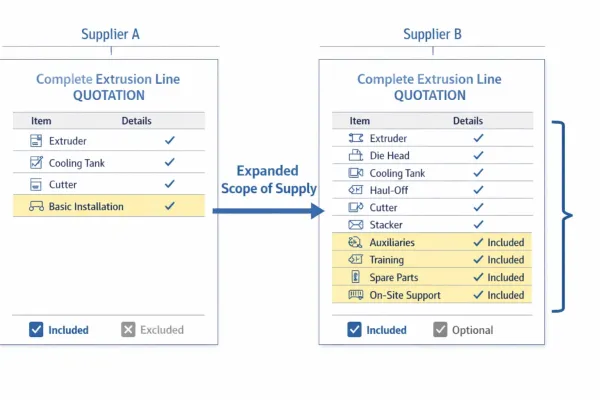
That is where many extrusion projects go wrong. The biggest surprise in line purchasing is not machine quality, screw design, or motor brand. It is scope of supply — the specific list of what is and is not included in the quoted price. One quotation may cover the die set, calibration unit, commissioning, spare parts, and training. Another may include only the core machine and downstream stations, treating everything else as optional or buyer-side responsibility.
Until those differences are made visible, price comparison is distorted. The lowest quote is often simply the narrowest quote.
This article gives you a practical framework for reading, comparing, and normalizing extrusion line quotations so you know exactly what you are paying for before you commit.
What a Complete Extrusion Line Actually Includes
Before you can evaluate a quotation, you need to know what a fully functional extrusion line consists of. A “complete line” is not one machine — it is a process system that converts raw plastic pellets into a finished product ready for packaging. For an overview of how all these components work together, see [→ What Is Plastic Extrusion Line?].
The exact configuration depends on the product, material, tolerance requirements, and factory layout. But the buyer should expect every quotation to state the supply boundary for each of these sections clearly.
1. Main Extruder
The core machine package. It typically includes:
- Extruder body — barrel, screw, gearbox, and motor
- AC drive system (inverter-controlled motor)
- Barrel heating zones and cooling fans
- Hopper (feed throat)
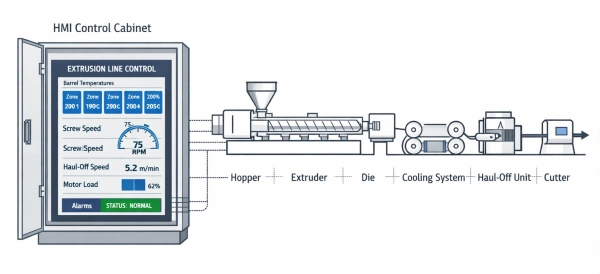
- Main control cabinet with PLC and HMI touchscreen [→ Extrusion Line Control System: What PLC and HMI Actually Do, and What to Evaluate]
This section is almost always included. If a supplier quotes an “extruder,” this is what they mean. But buyers often pay so much attention to extruder specs that they forget to challenge the rest of the line.
2. Die and Tooling
The die shapes the molten polymer into the desired cross-section:
- Extrusion die (pipe die, profile die, sheet die, etc.)
- Die adapter or transition piece
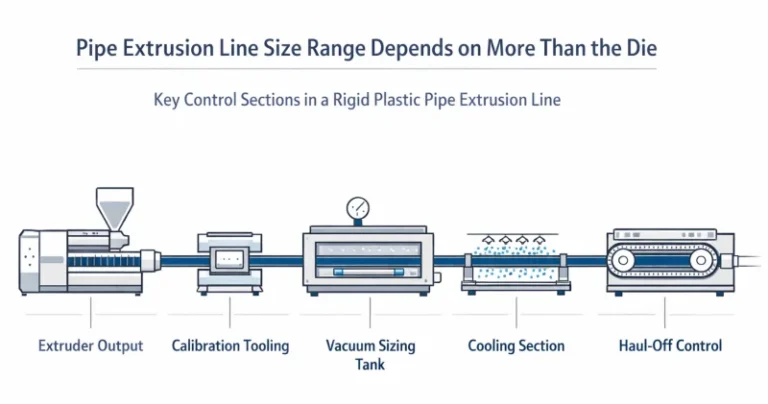
- For pipe and profile lines: calibration/sizing tooling matched to the die
This is one of the most common areas of quotation confusion. One supplier may include one die set for one product size. Another may include no die at all. A third may include tooling for one size range only. If you do not ask for exact quantity and exact size coverage, quotations are not aligned.
3. Downstream Equipment
Everything after the die that cools, shapes, pulls, and cuts the product. For a detailed explanation of each downstream station, see [→ Downstream Equipment in Plastic Extrusion]:
- Calibration unit — vacuum sizing tank (pipe) or dry calibration table (profile)
- Cooling section — spray tanks or immersion baths
- Haul-off / puller — maintains constant pulling speed and tension
- Cutting unit — saw, guillotine, or planetary cutter
- End-of-line handling — stacking table, tipping device, coiler, or winder
This section often creates hidden quotation differences because different products need different downstream logic. A profile line and a hose line may both be called “extrusion lines,” but their downstream requirements are not the same.
4. Line Control and Interconnection
This is the section many buyers overlook entirely.
Some suppliers quote each machine as a standalone unit but do not define how the line is electrically and logically integrated. Others include a coordinated control package for the full line — with speed synchronization between extruder, haul-off, and cutter [→ Extruder Output and Haul-Off Speed Synchronization], centralized alarm logic, and communication between stations.
A line that is physically present is not automatically a line that is operationally integrated. Verify whether machine interconnection, synchronization logic, and centralized line control are within the supplier’s scope or partially left to you.

What Is Typically NOT Included — and Where Extrusion Line Quotations Diverge
Many procurement disputes begin with a simple sentence: “We thought that was included.”
That sentence usually appears late in the project — after PO, after shipment, sometimes after the machine is already on the factory floor. The best way to avoid it is to know which items are frequently excluded unless explicitly stated.
Utilities and Infrastructure
- Cooling water system (chiller or cooling tower). The line needs cooled water, but the chiller itself is often quoted separately or assumed to exist at your facility. A quote that includes a vacuum tank but excludes the cooling source is not wrong — it is only dangerous when the exclusion is not obvious.
- Compressed air supply. Required for pneumatic actuators on haul-offs, cutters, and other stations. The compressor is almost never part of the line quotation.
- Power cabling. The main cable from your factory’s distribution board to the machine panel is your responsibility. If your facility voltage does not match, a transformer is also on you.
- Water piping and drainage. Supply and return lines between chiller and cooling tanks, plus waste water handling near the cooling section.
Material Handling
- Material loader / conveyor. Often excluded. In some projects that is reasonable; in others it creates startup delays because the buyer assumed continuous feeding was covered.
- Material dryer. Essential for hygroscopic resins (PA, PET, PC, ABS). Usually a separate purchase. For why drying matters, see [→ Why Resin Drying Matters in Plastic Extrusion].
- Gravimetric blender / dosing unit. For mixing base resin with color masterbatch or additives. Frequently excluded or listed as optional.
Additional Tooling
- Additional die sets. Each product size needs its own die and matching calibration tooling. Never accept vague wording like “one set of molds included” without confirming what that means — one die for one diameter is not a tooling package covering your commercial range.
- Sizing sleeves and calibration inserts. Each diameter requires its own sleeve for the vacuum tank.
- Initial spare parts and tools. Heater bands, thermocouples, cutter blades, fuses, special wrenches — some suppliers include a starter kit, others do not.
Process Enhancement Equipment
Not required for every line, but they solve specific production problems:
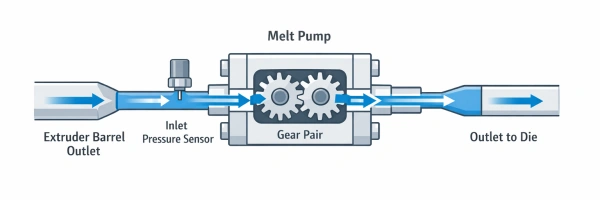
- Melt pump — stabilizes melt pressure for tight-tolerance products
- Inline measurement — ultrasonic wall thickness gauge, laser OD gauge, ovality measurement
- Printer / marking system — for product identification, date coding, or meter marking
Services and Commercial Items
- Shipping, insurance, customs. Almost always excluded. Shipping terms (FOB, CIF, DDP) dramatically affect what you actually pay.
- Installation supervision. Some suppliers include commissioning engineer days; others charge separately (typically a daily labor fee per engineer, plus buyer-covered flights, hotel, and visa).
- FAT (Factory Acceptance Test). May or may not include trial material. Best practice: ship two bags of your actual production resin to the supplier before FAT so the test run uses the same material you will run in production. This avoids post-delivery surprises caused by material differences — and eliminates a second round of on-site adjustment. Note that this creates a hidden cost: import duties on incoming resin samples typically run around $150 per shipment, borne by the supplier but often passed through.
- Operator and maintenance training. May be included, partial, or separate.
- Foundation and civil works. Floor preparation, anchoring, facility modifications.
- Packing specification. Seaworthy wooden crate vs. standard packing — matters for overseas shipments.

How to Compare Quotations on the Same Basis
The problem with comparing extrusion line quotations is not that suppliers are hiding information. It is that different suppliers structure their quotations differently. One bundles the chiller into the price. Another lists it as optional. A third does not mention it at all.
Here is how to normalize the comparison.
Step 1: Build a Master Item List Before You Send the RFQ
Before contacting any supplier, create a single checklist of every item your production needs. Use the checklist at the end of this article as your starting point and adapt it to your product and facility.
Step 2: Require a Standardized Response Format
For each item on your checklist, ask every supplier to mark one of four responses:
- Included — covered in the quoted price
- Not Included — excluded from scope entirely
- Optional — available at additional cost (with price listed)
- By Buyer — buyer’s responsibility to source and provide
This converts every supplier’s proposal into the same format. Hidden exclusions become visible. Decoding different quotation styles becomes unnecessary.
Step 3: Calculate the True Landed Cost
Add up:
- Quoted machine price
- All “not included” and “by buyer” items you still need to purchase
- Shipping + insurance + customs duties
- Installation supervision and commissioning fees
- Training costs
- Facility modifications required
This total — not the headline quote — is what you should compare. For a deeper framework on evaluating total cost of ownership beyond the purchase price, see [].
Example: How Scope Changes the Real Price
| Item | Supplier A | Supplier B |
|---|---|---|
| Quoted line price | $30,000 | $42,000 |
| Chiller | Not included ($2,300) | Included |
| Material loader + dryer | Not included ($920) | Included |
| 2nd die set + calibration | Not included ($2,300) | Included |
| Seaworthy wooden crate packing | Not included ($1,800) | Included |
| Shipping (CIF, long distance) | $4,500 | $4,500 |
| Commissioning (2 engineers × 7 days) | $1,080 | Included |
| True landed cost | $42,900 | $46,500 |
*Commissioning labor fee only. Flights, hotel, and visa are typically borne by the buyer regardless of supplier.
At first glance, Supplier A looks $12,000 cheaper. After adding everything the buyer still needs to purchase, the real gap shrinks to just $3,600. The 29% headline discount is actually less than 8% once scope is normalized.
But the comparison does not stop here. Even after scope is aligned, the two quotations may still not be equal — because what is included matters as much as whether it is included. That is where component-level detail comes in, as discussed in the next section.
Beyond Scope: Not All “Included” Items Are Equal
Even when two quotations list the same items, the specifications behind those items may be very different.
- Inverter drives. Both suppliers may write “ABB inverter.” But one uses a high-performance series (such as the ABB ACS580) with built-in process PID control, while the other uses a basic-duty economy model. The price gap between the two is significant — and so is the difference in process stability, energy efficiency, and long-term reliability.
- Electrical interface standards. One supplier delivers equipment with industrial three-phase power connections ready for direct hookup at your facility. Another delivers with connectors that require a voltage converter or adapter on-site — an unexpected cost, a potential failure point, and a delay you did not plan for.
- Component sourcing depth. Two quotations may both say “Siemens PLC” or “SKF bearings,” but the model series and specification level matter. A brand name on a quotation is not the same as a verified part number.
This is why a scope checklist alone is not enough. Once scope is aligned, the next step is to compare component-level specifications within each module — especially for drives, motors, control systems, sensors, and any electrical interface that connects to your factory infrastructure.
A useful RFQ practice: ask suppliers to list the exact brand and model number for all key components (inverter, PLC, motor, temperature controller, pressure transducer). This turns vague brand claims into verifiable specifications — and often reveals where the real cost difference is hiding.
What to Write in Your RFQ
If you want better quotations, start with a better RFQ. A good RFQ should not stop at “We need a pipe extrusion line” or “Please quote one profile line.” That is too loose — it invites every supplier to define the scope differently.
Define the Process Basis First
- Product type and cross-section or drawing
- Material (and whether recycled content is involved)
- Dimensional tolerances
- Target output rate (kg/h or m/min)
- Line speed requirements
- Utility standards at your site (voltage, frequency, water supply)
- Space or layout constraints
Then Require Explicit Scope Answers
Attach your checklist and require the supplier to complete it. Additionally, before accepting any quotation for comparison, make sure it answers these 12 questions:
- What exactly is included in the main machine package?
- How many die sets are included, and for which product sizes?
- Are feeding, drying, or dosing systems included?
- Is the chiller or cooling-water source included, or only the connection point?
- Is compressed air supply included, or only required as buyer-supplied?
- Is line interconnection and centralized control included between all stations?
- Are startup spare parts and special tools included?
- Is FAT included, and with what test basis and trial material?
- Is on-site commissioning included, and for how many days?
- Is operator and maintenance training included, and for how many people?
- What shipping term is used (FOB / CIF / DDP)?
- What is explicitly excluded?
A supplier that answers these questions clearly is easier to compare, easier to negotiate with, and usually easier to work with after purchase.
Scope of Supply Checklist
This is a reference checklist you can adapt for your own RFQ. For each quotation you receive, mark every item as Included / Not Included / Optional / By Buyer.
A. Product and Process Basis
- Product type: ___
- Material: ___
- Product drawing / sample: ___
- Layer structure (if multi-layer): ___
- Output target: ___ kg/h
- Line speed target: ___ m/min
- Dimensional tolerance: ___
- Surface quality requirement: ___
B. Main Equipment
- Extruder (barrel, screw, gearbox, motor, drive)
- Control cabinet (PLC + HMI touchscreen)
- Barrel heaters and cooling fans
- Hopper
- Safety guarding and E-stop circuits
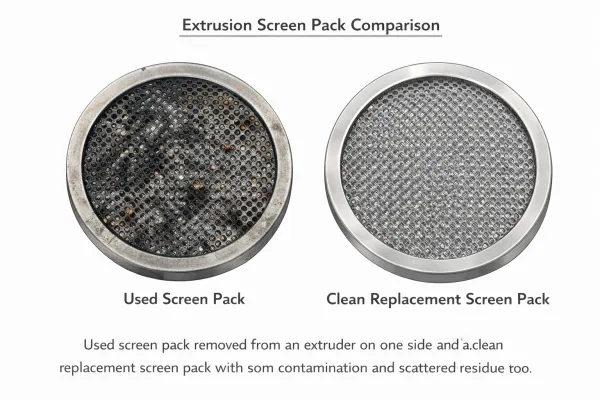
- Screen changer: Included / Not Included / Optional
- Melt pump: Included / Not Included / Optional
C. Die and Tooling
- Extrusion die — Quantity: (specify sizes: )
- Die adapter / transition piece
- Calibration sleeves / sizing tooling — Quantity: ___
D. Downstream Equipment
- Vacuum / spray calibration tank
- Cooling bath(s)
- Haul-off / puller
- Cutting unit (type: ___)
- Stacking table / coiler / winder
- Receiving / tipping device
E. Upstream / Material Handling
- Material loader / vacuum conveyor
- Material dryer (type and capacity: ___)
- Gravimetric blender / dosing unit
F. Auxiliary Equipment
- Chiller or cooling tower
- Compressed air system
- Water piping (supply and return to line)
- Main power cable to electrical panel
- Inline measurement (wall thickness, OD, ovality)
- Printer / marking system
G. Delivery and Services
- FAT: Included / Not Included / Optional
- Trial material for FAT: Included / Not Included / By Buyer
- Shipping terms: FOB / CIF / DDP
- Packing (seaworthy / standard): ___
- Insurance: Included / Not Included
- Installation supervision — ___ days included
- Commissioning and test run
- Operator training — persons, days
- Maintenance training
- Startup spare parts kit: Included / Not Included / Optional
- Tool kit: Included / Not Included / Optional
H. Documentation
- Mechanical / GA drawings
- Electrical schematics
- Operating manual (language: ___)
- Recommended spare parts list with part numbers
I. Commercial Boundary
- Warranty period: (start point: delivery / commissioning / )
- Utility hookup: By Buyer / By Supplier
- Local installation and civil works: By Buyer / By Supplier
- Explicit exclusions: ___
- Special assumptions: ___
Conclusion: Scope First, Price Second
A good extrusion line purchase does not start with asking which supplier is cheapest. It starts with asking whether the quotations describe the same project.
If the scope is unclear, price comparison is misleading. If the scope is aligned, comparison becomes faster, cleaner, and far more useful. At that point, you can start judging real value: machine quality, service capability, delivery reliability, energy efficiency, and total cost over time.
A scope checklist will not eliminate every project risk. But it will eliminate one of the most common and most expensive ones: discovering too late that “complete line” did not mean the same thing to both sides.
If you are evaluating quotations now, send us your product drawing, material spec, target output, and the quotations you already received. We can help you turn them into a standardized scope comparison so you can see exactly where the real gaps are — before you commit.
Frequently Asked Questions
Q1: Why do extrusion line quotations from different suppliers vary so much in price?
A: Almost always because the scope of supply is different. One supplier may include the cooling system, material dryer, and multiple die sets, while another quotes only the core machine and downstream. The equipment quality may be comparable — the price gap comes from what is and is not covered.
Q2: What items are most commonly missing from extrusion line quotations?
A: Cooling water systems (chillers), material handling equipment (loaders, dryers), additional die sets for different product sizes, line interconnection and centralized control, and commissioning services. These are the items buyers most often discover they need after the purchase is made.
Q3: Should I always choose the supplier with the most complete scope?
A: Not necessarily. If you already own chillers, dryers, or loaders from existing lines, a leaner quotation may be the better value. What matters is that you understand exactly what each supplier is and is not covering, so your comparison is based on the same total investment.
Q4: How many die sets should I include in my RFQ?
A: Request pricing for every product size you plan to run within the first year. Each die and its matching calibration tooling is a separate cost, and ordering them later — especially from a different supplier — often costs more and risks compatibility issues with the line.
Q5: What does “commissioning included” actually mean?
A: It varies widely. Some suppliers include only remote support by phone or video. Others include a specified number of on-site engineer days. Always confirm: how many days on-site, who pays travel and accommodation, what defines successful commissioning (the acceptance criteria), and whether operator training is part of commissioning or charged separately.
Have Technical Questions?
Our engineering team is ready to help with your extrusion process or machine configuration.
Jason Shen
Jason is the founder of Jinxin Extruder and a veteran engineer with over 20 years of hands-on experience in plastic machinery.
Starting his career on the shop floor, he mastered every technical detail—from electrical wiring to complex troubleshooting.
Today, he personally oversees final inspections, ensuring every machine is built with deep technical expertise and field-tested reliability.
Further Reading
Extrusion Screen Changer & Melt Filtration: How to Reduce Contamination and Pressure Fluctuation
A practical guide to screen changers in plastic extrusion — how melt filtration controls contamination, why screen changes cause pressure…Melt Pump for Extrusion: When It Helps and When It Is Not Necessary
Learn what a melt pump for extrusion actually does, how it differs from melt pressure sensor closed-loop control, when it…