Extrusion Line Control System (PLC/HMI): What It Does and How to Evaluate It
Open any quotation for an export-grade plastic extrusion line and you will almost certainly see “PLC control + HMI touch screen” listed as a standard feature. Nearly every supplier includes it. The phrase has become so common that it is easy to treat it as a checkbox — present or absent — and move on to comparing motor power or screw diameter.
That would be a mistake.
In our project discussions, one of the most common misunderstandings we see at the quotation stage is exactly this: buyers assume that because every supplier lists “PLC + HMI,” the extrusion line control system is roughly similar across offers. It is not. Two lines that both carry the same label on the spec sheet can behave very differently in actual production — in how temperatures are managed, how speeds are coordinated, how alarms are handled, how fast a changeover can happen, and how much the system depends on operator judgment versus automated logic. The difference is not whether a PLC is present, but how much the control system actually does in production.
This article is written for two groups of readers:
Technical staff who will operate and maintain the line — and who care most about easy operation and easy maintenance.
Procurement and management who evaluate the line as a business investment — and who care most about fewer mistakes, less downtime, and lower dependence on any single operator’s memory.
The following sections explain what PLC and HMI actually do on an extrusion line, why recipe management is often the most valuable daily-use function, and how to evaluate an extrusion line control system by practical production fit rather than brand label alone.
A usable extrusion line control system should be judged by what it actually controls in production — not by the mere presence of a PLC and touch screen.
What PLC and HMI Actually Do on an Extrusion Line
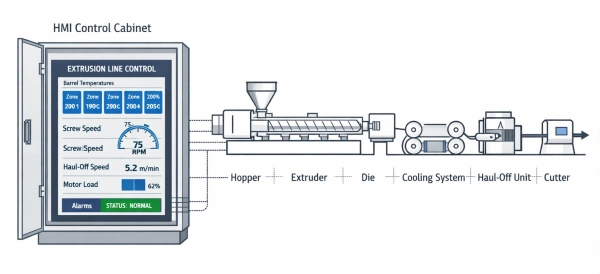
A PLC (Programmable Logic Controller) is not an advanced option or a premium upgrade. On a modern extrusion line, it is the automation core — the controller that executes the logic keeping every section of the line running together. It is the foundation of any serious extrusion process control setup.
An HMI (Human Machine Interface) is the touch screen — the extruder control panel — through which operators interact with that controller. Together, they replace what used to be a panel of independent switches, dials, and separate controllers with one integrated operating system for the entire line.
What the PLC actually controls
In daily production, the PLC continuously executes programmed logic across three main areas:
1. Closed-loop temperature control
Each heating zone on the barrel and die has a setpoint. The PLC reads the actual temperature from thermocouples, compares it to the setpoint, and adjusts heater output automatically. If a zone drops below target — because ambient conditions shifted, or a heater band is aging — the system compensates before the operator needs to notice.
This matters because temperature drift is a common source of dimensional variation and surface inconsistency in extrusion. A control system that holds temperature within a tight band, automatically, removes one of the largest sources of production variation.
2. Speed coordination
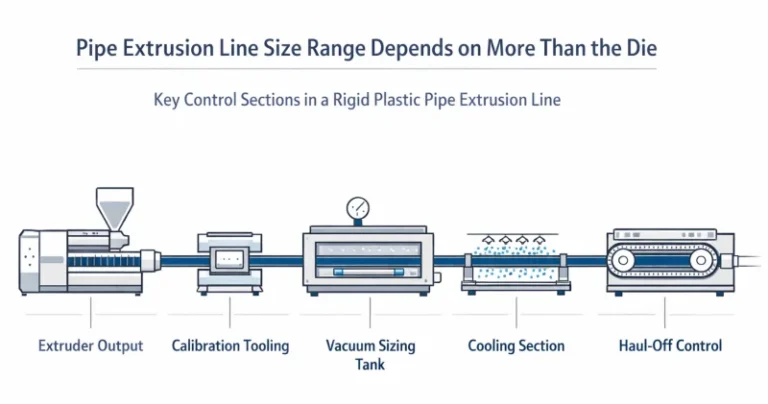
An extrusion line is not one machine. It is a chain of machines — extruder, haul-off, cutter, and other downstream equipment — that must run at matched speeds. The PLC manages the speed relationships between sections. When haul-off speed is adjusted, the system can coordinate upstream or downstream parameters to maintain the correct ratio. Without this, every speed change becomes a manual balancing act that risks wall thickness drift or dimensional instability.
3. Alarm logic and protective response
The PLC continuously monitors motor current, melt pressure, temperature deviation, and equipment status. When an abnormal condition occurs — motor overload, pressure spike, temperature runaway — the system executes a protective sequence: reduce speed, shut down a section, or stop the line, depending on severity.
This is not just equipment protection. It reduces the window between “something went wrong” and “the system responded.” In a manual setup, that window depends entirely on whether the operator noticed in time.
What the HMI provides
The HMI consolidates everything into one screen:
Parameter viewing: All critical values — zone temperatures, screw RPM, melt pressure, motor load, haul-off speed — displayed in real time.
Parameter setting: Process setpoints for the entire line entered from one location, with the PLC distributing and executing the commands.
Alarm history and fault location: When something goes wrong, the HMI shows what happened, where, and when — turning troubleshooting from guessing into a directed investigation.
What this looks like in daily operation
On a line without centralized control, an operator notices wall thickness drifting on the finished pipe. The operator walks the line checking individual gauges and controllers, adjusting one variable at a time, then waiting to see the result. This process can take significant time and may involve multiple rounds of adjustment.
On a line with a properly implemented PLC system, the same operator sees trend data on the HMI screen, checks whether any temperature zone has deviated, verifies the speed ratios are holding, and reviews the alarm log for any correlated event. The diagnostic process is faster because all the data is in one place, and adjustments can be made from one interface without walking the line repeatedly.
The difference is not dramatic on a good day. It becomes very real on a bad day — when multiple small deviations stack up and the operator needs to identify the actual root cause quickly rather than chasing symptoms.
Recipe management: the most valuable daily-use function
Recipe management deserves special mention because it solves one of the most common practical problems in extrusion production: product changeover.
When a line switches products — different pipe size, different profile, different specification — dozens of parameters must be reset: temperature setpoints for every zone, screw speed, haul-off speed, cooling parameters, alarm thresholds. Without recipe management, this depends on the experienced operator who carries parameter knowledge in memory. When that person is unavailable, the production team reconstructs settings from handwritten notes and trial and error. Startup takes longer, scrap rate during ramp-up is higher, and product consistency suffers.
A properly implemented recipe system allows the factory to store complete process settings as a named recipe tied to a specific product and die combination. When the same product runs again, the operator selects the recipe, the system loads the full parameter set in seconds, and the line starts from a known-good baseline — regardless of which operator is on shift. The practical impact: a factory that changes products twice a week saves dozens of hours per year in setup time, and avoids the scrap and quality risk that comes with manual parameter reconstruction.
Recipe management turns process knowledge from personal memory into a reusable factory asset.
How to Evaluate an Extrusion Line Control System
Our position on component selection
We do not use only one brand of PLC and HMI. This is a practical engineering choice, not a push toward either the cheapest or the most expensive option.
For the majority of our export extrusion lines, we use Wecon — a Chinese brand with a strong track record in overseas industrial applications. Wecon components cover the functional requirements of most standard and mid-range production lines: reliable closed-loop control, recipe management, alarm handling, and a stable HMI interface.
For higher-end production lines, or when a customer specifically requires it, we configure Siemens PLC and HMI components. This is always available as an option.
Our default recommendation is based on a principle: component choice should match the production requirement, not exceed it for the sake of appearing premium on the quotation. A customer producing standard PVC garden hose does not need the same control hardware as a customer producing precision medical tubing with tight tolerances. The production tasks are different; the right component selection is different.
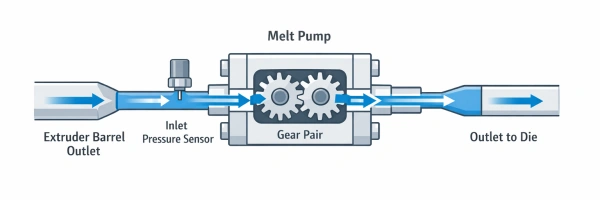
It is worth noting that a melt pump serves a different purpose: while the PLC coordinates speeds and temperatures through software logic, a melt pump mechanically isolates die pressure from screw fluctuation. These are complementary tools, not substitutes.

Five questions that reveal actual control capability
When comparing quotations across suppliers, these questions tell you more than “what brand PLC”:
1. What does the system actually control?
Some systems only manage barrel temperature zones. A more complete system also coordinates speed ratios between extruder, haul-off, and cutter, and includes alarm logic with automatic protective response. Ask the supplier to describe the scope of PLC logic — not just the hardware model.
What a weak answer looks like: “Siemens PLC, 10-inch touch screen.” (Hardware spec only, no description of control logic.)
What a useful answer looks like: “PLC manages 6 temperature zones with closed-loop PID, coordinates extruder-to-haul-off speed ratio, and includes alarm response for motor overload, pressure deviation, and temperature runaway.”
2. Does recipe management work properly?
Ask whether full parameter sets — all temperatures, all speeds, downstream settings — can be stored, named, and recalled per product/die combination. Some systems allow partial recipe storage only (temperatures but not speeds), which defeats half the purpose.
Red flag: The supplier cannot demonstrate recipe recall on the HMI, or the recipe only covers temperature zones.
3. How is the HMI organized for daily use?
A well-organized HMI lets the operator view all critical parameters, set all adjustable values, and access alarm history from one screen flow. A poorly organized one buries critical information behind multiple menus, or shows parameters without trend data.
What to ask for: Screenshots or a short video of the HMI screens. If the supplier cannot show you the actual interface layout, that is worth noting.
4. What is the alarm logic?
There is a meaningful difference between a system that displays a warning and one that executes a protective action. Ask whether the PLC reduces speed, shuts down a section, or stops the line automatically when specific fault conditions are detected — or whether it only shows a message and waits for the operator to respond.
Why it matters: At 2 AM on a night shift, the difference between “alarm displayed” and “alarm acted on” can be the difference between a minor event and a damaged screw or barrel.
5. What is the service and spare parts situation in your region?
A premium PLC brand with no local service support may be a worse practical choice than a mid-range brand with readily available parts and online diagnostic capability. Ask about spare parts lead time, remote support availability, and whether the HMI software can be updated or backed up by your own maintenance team.
What to check: Can you purchase replacement I/O modules, HMI panels, and communication cables without going through the machine supplier? If the answer is no, you have a long-term dependency risk.
The most practical extrusion line control system is not the most expensive one, but the one whose hardware, interface design, and support infrastructure match the real production task.
Conclusion
A good extrusion line control system determines how repeatable and manageable production really is.
For technical staff, the value is straightforward: one interface to monitor the line, one alarm system that points to the problem, one recipe library that eliminates the need to reconstruct parameters from memory. Easy operation and easy maintenance.
For buyers and management, the value is equally clear: fewer mistakes, less downtime, and lower dependence on any single person’s knowledge. A line that can be operated by a competent technician — not only by one irreplaceable expert — is a more manageable business asset.
The real value of an extrusion line control system is not that it looks more advanced on the quotation. It is that it makes production easier to run, easier to manage, and harder to get wrong.
Further Reading
To understand how an extrusion line works as a complete production system — and why line coordination matters beyond any single component — see What Is a Plastic Extrusion Line?
To understand the downstream equipment that the control system coordinates with — see Downstream Equipment in Plastic Extrusion
For a broader industry perspective on extrusion process control, see this overview from Plastics Technology.
Frequently Asked Questions
How is an extrusion line control system different from a standalone temperature controller?
A standalone temperature controller manages one zone independently. An extrusion line control system integrates temperature control, speed coordination, alarm logic, and recipe management into one PLC — so the entire line operates as a coordinated system, not a collection of independent devices.
Can I upgrade the control system on an existing extrusion line?
In most cases, yes. PLC and HMI components can be retrofitted, and the wiring can be adapted. The practical question is whether the cost of retrofit is justified compared to the remaining production life of the line. We evaluate this on a case-by-case basis.
Does a more expensive PLC brand always mean better production results?
No. Production results depend on what the PLC is programmed to do — the scope of control logic, recipe management, and alarm response — not on the brand label alone. A well-programmed mid-range PLC outperforms a premium PLC with minimal logic every time.
How many recipes can typically be stored?
This depends on the HMI memory and PLC configuration. On our standard Wecon setup, storage is sufficient for the recipe libraries of most factories running multiple product specifications. If your operation requires an unusually large number of stored recipes, this can be discussed during quotation.
What should I check during a Factory Acceptance Test regarding the control system?
Verify that recipe recall works correctly for at least two different product setups, confirm that alarm logic triggers protective response (not just a display message), and check that the HMI shows real-time trend data for temperature and speed. These three checks cover the most common gaps between “PLC included” and “PLC working as intended.”
Have Technical Questions?
Our engineering team is ready to help with your extrusion process or machine configuration.
Jason Shen
Jason is the founder of Jinxin Extruder and a veteran engineer with over 20 years of hands-on experience in plastic machinery.
Starting his career on the shop floor, he mastered every technical detail—from electrical wiring to complex troubleshooting.
Today, he personally oversees final inspections, ensuring every machine is built with deep technical expertise and field-tested reliability.
Further Reading
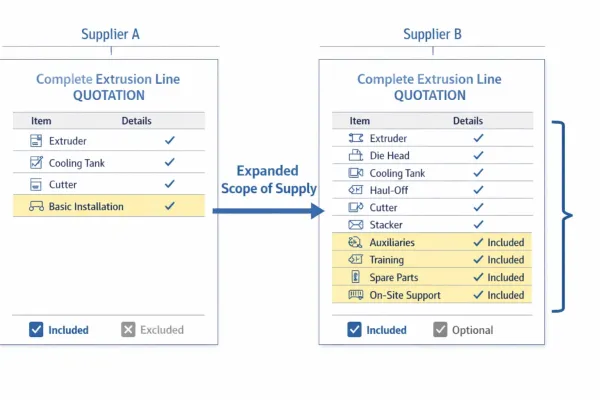
Extrusion Line Quotation: What Is Included and What to Check Before You Buy
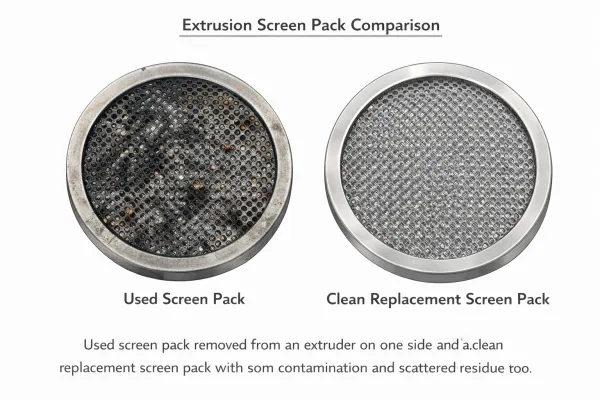
Comparing extrusion line quotations? Use this scope of supply checklist to see what is included, what is typically excluded, and…Extrusion Screen Changer & Melt Filtration: How to Reduce Contamination and Pressure Fluctuation
A practical guide to screen changers in plastic extrusion — how melt filtration controls contamination, why screen changes cause pressure…