Extrusion Screen Changer & Melt Filtration: How to Reduce Contamination and Pressure Fluctuation
When extruded products start showing black specks, gel particles, random surface marks, or short periods of dimensional instability, most processors look first at raw material, temperature settings, or die condition. Those are reasonable checks — but they are not always where the problem begins.
In many extrusion lines, the real starting point is the filtration system. The extrusion screen changer and its screen pack sit between the extruder and the die, doing more than catch dirt. It controls contamination, adds backpressure that affects melt behavior, and — when screens are changed — introduces pressure events that can propagate directly into product dimensions.
If the filtration setup is mismatched to the application, the result is usually not one dramatic failure. It is a pattern of avoidable problems: recurring surface defects, pressure drift, extra scrap after screen changes, and unnecessary downtime.
This article explains why filtration matters in extrusion, how an extrusion screen changer works, how to think about continuous versus manual screen changing, and what questions to ask when evaluating filtration as part of a line.
Why Extrusion Lines Need a Filtration System
A filtration system exists because molten polymer is rarely as clean as the finished product needs it to be. Even with high-quality virgin resin, the melt stream can carry contaminants — and once those contaminants pass the filtration point, they can show up as visible defects, damage die flow channels, or accumulate in places where they are harder to remove later.
Where Contamination Comes From
The contaminants in a polymer melt typically fall into three categories:
- Inherent material particles. Many resins contain small amounts of gels, high-molecular-weight agglomerates, or unmelted fragments that form during polymerization or pelletizing. These are not defects in the resin supply — they are a normal characteristic of polymer processing. For how different plastics behave in extrusion and why material properties matter, see [Common Plastics Used in Extrusion: A Practical Introduction to the Materials You See Most Often].
- Degradation byproducts. Thermal degradation inside the barrel can produce carbonized fragments, crosslinked particles, or discolored specks — especially during long runs, high-temperature operations, or when material stagnates in dead zones.
- Foreign contaminants. Metal particles from equipment wear, dust from handling, paper or fiber from packaging, and cross-contamination from previous runs. When recycled or regrind material is used, this category expands significantly.
What the Screen Pack Actually Does
The screen pack — typically one or more layers of woven wire mesh mounted on a breaker plate — sits in the melt path ahead of the die. Its function is often described simply as “catching particles.” That is true, but incomplete. In practice, the screen pack serves three roles:
- Contaminant retention. The most obvious function. Screens physically block particles larger than the mesh opening from reaching the die, preventing flow channel damage, die lip buildup, and surface defects on the finished product.
- Backpressure contribution. The screen pack creates flow resistance that increases melt pressure upstream. This added backpressure helps the screw’s metering section deliver more uniform shear and mixing. A clean screen adds only a modest amount of pressure — but as contamination accumulates, backpressure rises progressively, increasing screw load and potentially reducing output.
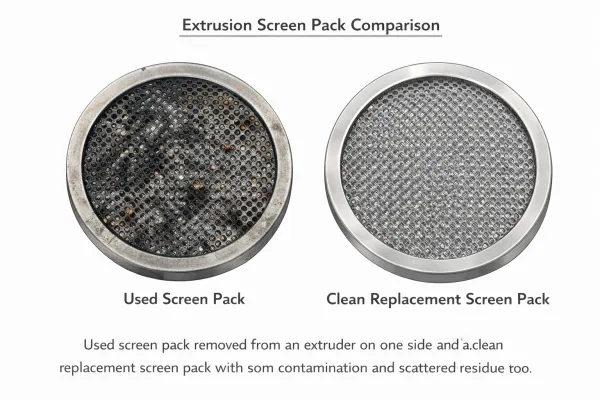
- Process diagnostics. A used screen pack is one of the most underused diagnostic tools in extrusion. Inspecting the screen after removal — looking at the color, distribution, and type of trapped material — can reveal information about resin quality, degradation patterns, and contamination trends that would otherwise be invisible.
What Happens Without Adequate Filtration
Running without filtration — or with filtration too coarse for the application — risks more than product surface defects:
- Die damage. Hard contaminants (metal particles, heavily crosslinked fragments) can score or block die flow channels, requiring costly maintenance or replacement.
- Unplanned downtime. A blocked die land or damaged flow channel often forces a line stop — far more disruptive and expensive than a planned screen change.
- Inconsistent quality. Without the backpressure contribution of a properly loaded screen pack, melt uniformity may degrade, leading to subtle but persistent variation in the finished product.
How an Extrusion Screen Changer Works
Before comparing different screen-changing methods, it helps to understand the basic mechanical structure and — more importantly — the pressure dynamics that drive most filtration-related quality problems.
Core Components
A typical melt filtration assembly consists of three elements:
- The screen (or screen pack). One or more layers of woven wire mesh that perform the actual filtration. Finer mesh catches smaller particles but generates more backpressure.
- The breaker plate. A perforated steel disc that supports the screen pack against the melt pressure. Without it, the screen would deform or rupture under load.
- The screen changer body. The housing that holds the screen pack and breaker plate in the melt stream and provides a mechanism for replacing the screen when it becomes loaded.

How Backpressure Builds Over Time
When a fresh screen is installed, it adds relatively small flow resistance. As it traps contaminants, the effective open area decreases and backpressure rises. This is not inherently a problem — moderate backpressure contributes to melt uniformity. But as contamination accumulates:
- Backpressure continues to climb
- Screw motor load increases
- Melt temperature may rise due to increased shear energy
- Output may gradually decrease
At some point, the screen must be changed. And this is where the most significant process variable enters.
The Pressure Drop Event
When a loaded screen is removed and replaced with a fresh one, flow resistance drops suddenly. This is not a subtle shift — it is an abrupt pressure change that propagates through the melt stream to the die exit.
As extrusion specialist Allan Griff notes: “When clogged screens are changed, pressure suddenly drops, melt temperature may do the same, and either screw rpm or line speed must be adjusted to maintain the same product dimensions.” He adds that for profile and flat-die products, “the melt-temperature change may affect the product shape.” (Plastics Technology — Get Smart About Screens)
This pressure drop event is the central cost of manual screen changing. The sudden shift in melt delivery at the die exit causes:
- Wall thickness variation in pipe and tube products
- Dimensional shifts that persist until the process re-stabilizes
- A scrap segment of product extruded during the pressure transition that does not meet tolerance
For products with tight requirements, this scrap segment represents significant material and time loss — especially when screen changes are frequent.

Continuous vs. Manual Screen Changing
This is the equipment decision most buyers need to understand. The choice is not about “better” or “worse” — it is about matching the screen changer to the actual production conditions.
Manual Screen Changing (Slide Plate / Bolt Type)
How it works: The line is stopped or slowed. The operator removes the screen holder, replaces the loaded screen pack with a fresh one, and re-engages the holder. The line is then brought back up to speed.
Where it fits:
- Simple, proven mechanical design with lower equipment cost
- Straightforward maintenance — fewer components, easier to service
- Well suited to operations where screen changes are infrequent and the product has a comfortable process window
- Practical for short-run, multi-product lines where the line already stops regularly for color or material changes — screen changes can be folded into existing downtime
The trade-off: Every screen change produces a pressure drop event. For products with tight tolerances, each change generates a scrap segment and requires the process to re-stabilize.
Continuous Screen Changing
How it works: Continuous screen changers use dual-station or hydraulically driven designs that allow one section of screen to be replaced while the other remains in the melt stream. The transition is managed so that pressure fluctuation during the changeover is minimized — not eliminated, but reduced to a range most products can tolerate.
Where it fits:
- Dimensionally sensitive products (thin-wall tubing, optical profiles, precision tube) where even brief pressure disturbances create visible defects
- High-regrind or recycled material operations where screen changes are frequent
- Long continuous runs where each interruption costs significant production time and scrap
The trade-off: Higher equipment cost, greater mechanical complexity, and — critically — different operating logic. A continuous screen changer cannot be operated with the same approach as a manual one.
As Parkinson Technologies warns: “Not knowing and understanding these two data points [clean screen pressure and acceptable pressure rise] will lead to an incorrect pressure control set point… This leads to the belief that continuous belt-style machines should be operated similarly [to slide plate machines]. This is never the case.” (Parkinson Technologies — Timed vs Pressure Control)
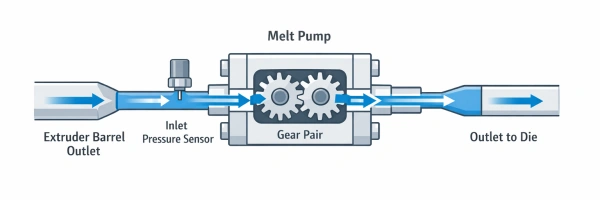
Continuous screen changers that are paired with pressure sensor feedback and proper control set points deliver the most stable results. This is also a natural integration point with melt pump systems — for how gear pumps and pressure sensors work together to stabilize output, see [→ Melt Pump for Extrusion: When It Helps and When It Is Not Necessary].
Decision Framework
| Dimension | Manual fits better | Continuous fits better |
|---|---|---|
| Product precision requirement | Medium to low tolerance | Tight tolerance (thin wall, optical, medical) |
| Feedstock cleanliness | Clean virgin material (low change frequency) | Recycled / regrind content (frequent changes) |
| Downtime cost tolerance | Acceptable (short runs, flexible schedule) | Not acceptable (continuous high-output runs) |
| Production pattern | Small batch / multi-product changeovers | Long continuous runs / high volume |
| Budget priority | Lower capital cost | Lower total operating cost over time |
How Filtration Directly Affects Product Quality
A filtration system rarely announces itself as “the problem.” It usually shows up through symptoms that look like they could come from somewhere else. This section maps common quality problems to their filtration-related causes — so you can assess whether your own issues might trace back to the screen changer setup.
Black Specks and Gel Particles
What you see: Small dark spots or translucent lumps on or embedded in the product surface.
Filtration connection: Screen mesh too coarse for the application allows larger contaminant particles — carbonized fragments, gels, crosslinked material — to pass through and reach the die. In transparent or light-colored products, even small particles become clearly visible defects.
For a systematic approach to tracing the source of black specks (filtration, degradation, or contamination), see [→ Black Specks in Extrusion: How to Trace the Real Source].
Surface Streaks and Flow Lines
What you see: Longitudinal lines or subtle texture variations running along the extrusion direction.
Filtration connection: Partial, uneven screen blockage creates non-uniform flow resistance across the screen area. This produces pressure distribution differences in the melt entering the die, which translate into velocity differences across the cross-section — visible as surface streaks.
Dimensional Fluctuation
What you see: Periodic or intermittent shifts in wall thickness, outer diameter, or cross-section geometry.
Filtration connection: The pressure drop event during screen changes propagates to the die exit as a temporary shift in melt delivery rate. Product extruded during this transition shows measurable dimensional variation. Pressure instability from a gradually clogging screen can also cause slower, more subtle dimensional drift.
For diagnosing wall thickness variation from all common causes (not just filtration), see [→ Extrusion Wall Thickness Variation: Causes, Diagnosis, and Quick Fixes].
Color Inconsistency (Recycled Content)
What you see: Subtle color shifts, off-color streaks, or visible specks of different shade.
Filtration connection: Recycled or regrind feedstock often contains small amounts of different polymer types, colorants, or degraded material. If screen mesh is too coarse to capture these particles, they pass through and appear as color inconsistencies — especially visible in light-colored or translucent products.

Self-Diagnosis
If you are experiencing any of the above and have not recently evaluated your filtration setup — mesh selection, change frequency, change method, and pressure behavior during changes — that is usually a productive place to start. If filtration appears adequate but surface defects persist, the root cause may lie elsewhere in the process. For a broader diagnostic framework, see [→ Plastic Extrusion Troubleshooting: A Practical Guide to Diagnosing Line Problems Fast].
When You Do Not Need a Continuous Screen Changer
Not every extrusion line benefits from continuous screen changing. This is the section many suppliers skip — but it matters, because upgrading when operating conditions do not require it adds cost and complexity without meaningful return.
Clean virgin material + moderate-tolerance products. When processing high-purity virgin resin, screen loading is slow and changes are infrequent. If the product has a comfortable dimensional window, the scrap from a manual screen change is short and acceptable. A simple slide plate or bolt-type changer is fully adequate.
Short-run, multi-product lines. Lines that frequently change colors, materials, or product types already build planned stops into their cycle. Screen changes can be folded into existing downtime — there is no additional penalty for stopping, because the line is already stopping for other reasons.
Wide process window + existing pressure control. Some products have tolerances wide enough that the pressure disturbance from a manual screen change falls within the acceptable range. If the line also has pressure sensor feedback that allows compensation, the practical impact of manual changing may be minimal.
The core principle: do not upgrade for the sake of upgrading. Screen changer selection should be driven by two variables — how often you actually need to change screens (determined by contamination level) and how much dimensional disruption your product can tolerate during a change event. If both point toward “infrequent changes” and “tolerant product,” a manual system is the right choice.
What to Ask in Your RFQ
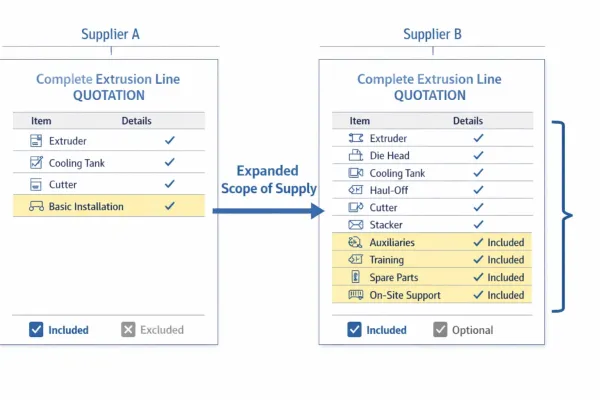
When evaluating extrusion line quotations, the filtration section is often underdefined in supplier proposals. These questions help you understand what you are actually getting — and whether it matches your production conditions.
1. Filtration range. What screen mesh configurations can the system accept? Can it accommodate different mesh sizes as your material or product requirements change?
2. Screen change method. Is it manual slide plate, semi-automatic, or fully automatic continuous? Does changing require a full line stop, a speed reduction, or neither? This directly determines how much production disruption each change event causes.
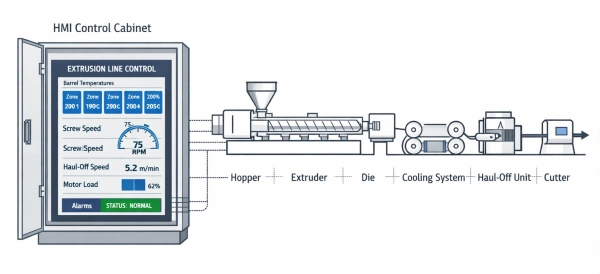
3. Pressure behavior during screen change. What is the expected pressure fluctuation range? Is the system equipped with — or compatible with — pressure sensor feedback for closed-loop control? For dimensionally sensitive products, this is one of the most important specifications to clarify.
4. Maintenance and operator requirements. How many operators are needed for a screen change? What safety features exist for hot-condition operation? How accessible is the screen changer for routine cleaning and inspection?
5. Material compatibility. What melt viscosity range can the screen changer handle? Are there design features for highly filled materials (glass fiber, mineral fillers) or abrasive feedstocks? Materials that cause rapid screen loading or high wear need different engineering than clean, low-viscosity resins.
Conclusion
An extrusion screen changer is not just a hardware accessory between the extruder and the die. It is part of the process logic of the line.
The filtration system has to do two jobs at once: keep contamination out of the melt, and do that without creating pressure behavior the product cannot tolerate. The best choice is not “manual versus continuous” in the abstract — it is the one that matches your contamination load, screen-change frequency, product tolerance, and downtime cost.
If you’re seeing surface defects or dimensional fluctuation and haven’t evaluated your filtration setup recently, that’s usually the first place to look. Share your material spec and production requirements — we can help you identify whether your current screen setup is the likely cause.
Frequently Asked Questions
Q1: What is an extrusion screen changer?
A: An extrusion screen changer is a device mounted between the extruder and the die that holds the melt filtration screen pack in the flow path. It provides a mechanism for replacing loaded screens — either by stopping the line (manual type) or by switching between filter stations during production (continuous type). Beyond filtration, the screen pack also contributes backpressure that affects melt mixing and process stability.
Q2: How does a continuous screen changer work?
A: Continuous screen changers use dual-station designs (such as dual-bolt, dual-piston, or continuous belt systems) that keep one filter position active in the melt stream while the other is taken offline for screen replacement. This allows the line to continue running during changes, minimizing the pressure disturbance that would otherwise occur with a full stop-and-change event. Different designs achieve this in different ways, but the engineering goal is the same: maintain melt flow and pressure stability during screen renewal.
Q3: How often should you change screens on an extruder?
A: Screen change frequency depends on material cleanliness, filtration mesh fineness, and acceptable backpressure rise. With clean virgin resin, changes may be needed only every several hours or even shifts. With recycled or contaminated feedstock, changes may be needed much more frequently. Most operations monitor melt pressure upstream of the screen pack — when pressure rises to a predetermined threshold above the clean-screen baseline, it is time to change.
Q4: Can a screen changer cause dimensional problems in extruded products?
A: Yes. When a loaded screen is replaced with a fresh one, the sudden drop in flow resistance creates a pressure event that propagates to the die exit. This causes a temporary shift in melt delivery rate, which can show up as wall thickness variation, OD fluctuation, or cross-section geometry changes. The magnitude depends on how much the screen was loaded before change and how sensitive the product is to pressure disturbance.
Q5: What is a breaker plate and why does it matter?
A: The breaker plate is a perforated steel disc that sits behind the screen pack and supports it mechanically against the melt pressure. Without a breaker plate, the screen would deform or rupture under load. It also helps convert the rotational flow from the screw into more linear flow before the melt enters the die.
Further Reading
Plastics Technology / Griffex — Get Smart About Screens (Allan L. Griff)
https://griffex.com/wp-content/uploads/2020/09/Griff-screensPT.pdf
Parkinson Technologies — Screen Changer: Timed vs Pressure Control Screen Movements
Have Technical Questions?
Our engineering team is ready to help with your extrusion process or machine configuration.
Jason Shen
Jason is the founder of Jinxin Extruder and a veteran engineer with over 20 years of hands-on experience in plastic machinery.
Starting his career on the shop floor, he mastered every technical detail—from electrical wiring to complex troubleshooting.
Today, he personally oversees final inspections, ensuring every machine is built with deep technical expertise and field-tested reliability.
Further Reading
Extrusion Line Quotation: What Is Included and What to Check Before You Buy
Comparing extrusion line quotations? Use this scope of supply checklist to see what is included, what is typically excluded, and…Melt Pump for Extrusion: When It Helps and When It Is Not Necessary
Learn what a melt pump for extrusion actually does, how it differs from melt pressure sensor closed-loop control, when it…