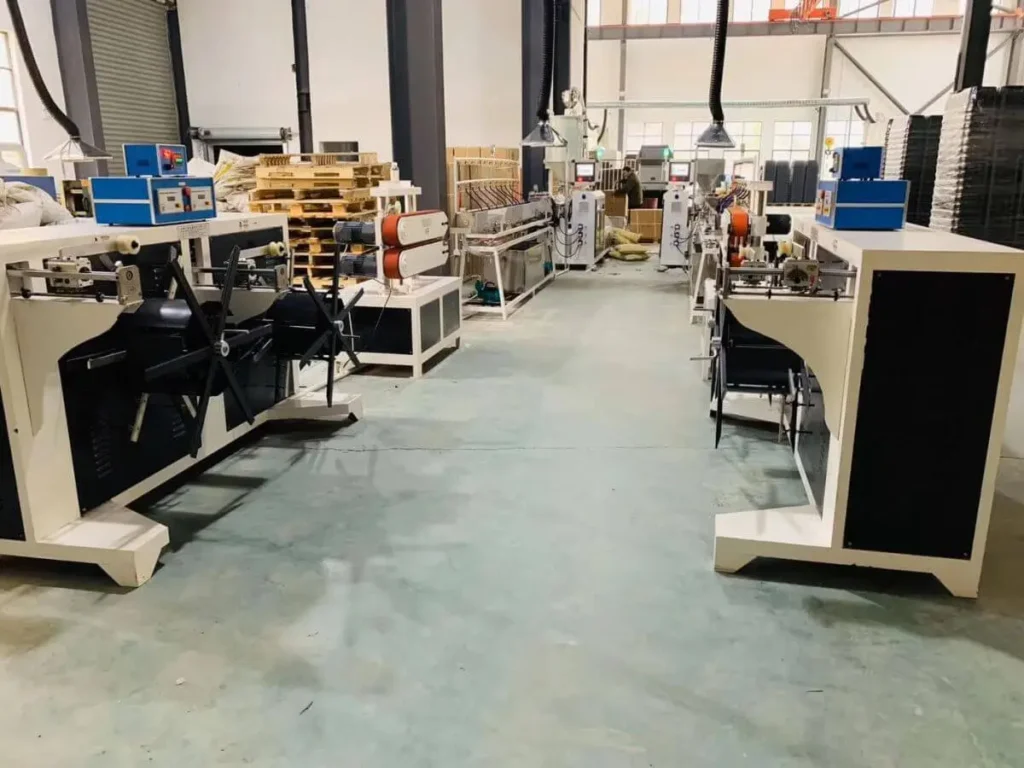
What Is Plastic Extrusion Line? From Extruder to Full Production System
Why “Plastic Extrusion Line” Is Not the Same as “Plastic Extruder Machine”
When buyers search what is plastic extrusion line, many are actually picturing a single machine — the extruder. It is easy to assume that if the extruder can melt plastic and push it through a die, the production problem is basically solved.
It is not.
Three terms are constantly mixed together in real discussions, but they do not mean the same thing. Plastic extrusion is widely used in industrial manufacturing systems, as described in engineering references such as ScienceDirect – Extrusion Process. A plastic extruder machine is the core processing unit that conveys, melts, mixes, and pressurizes the material.
A plastic extrusion line is the complete production system that turns that process into continuous, stable, commercially usable manufacturing — from raw material entry to finished product discharge.
That distinction matters because the extruder solves only one critical part of the problem: creating a processable melt. The extruder alone does not lock final dimensions, stabilize product shape, coordinate line speed, control downstream cooling behavior, or deliver finished goods in a form the buyer can actually sell.
This article does not repeat the basic extrusion process itself — that belongs in [→ What is Plastic Extrusion?]. It also does not go deep into screw and barrel structure — that belongs in [→ What Is an Extruder Machine?]. This article focuses on something different: what a full plastic extrusion line actually is, how it works as a complete plastic extrusion system, and why whole-line matching matters more than any single machine specification.
1. What Is Plastic Extrusion Line? A Practical Definition
A plastic extrusion line is a complete production system used to continuously convert raw plastic material into finished products with a consistent cross-section and repeatable quality.
That definition is short, but every word in it matters.
Complete means the plastic extrusion line is not a single machine. It includes material entry, pre-treatment where needed, melt formation, die shaping, downstream cooling and sizing, haul-off, and final product handling. If one of those stages is missing, you may still be able to make a sample, but you do not yet have a full production system.
Continuously means the goal is not to make one short piece successfully and stop. A plastic extrusion system is meant to run for hours, shifts, and repeated production cycles while holding stable operating conditions. A setup that looks good for five minutes and then drifts is not yet behaving like a real production line.
Finished product means the target is not “melt came out of the die.” The target is a product that meets dimensional tolerances, appearance requirements, and delivery conditions. Until the product has been shaped, cooled, stabilized, pulled at a matched speed, and discharged in the correct form, it is not finished from a buyer’s point of view.
A useful short answer is this:
A plastic extruder machine answers whether plastic can be melted and pushed forward. A plastic extrusion line answers whether a finished product can be made continuously, stably, and in a commercially deliverable way.
That is the real answer to what is plastic extrusion line — not a machine list, but a system definition.
What is a plastic extrusion line? A plastic extrusion line is a complete manufacturing system that continuously turns raw plastic material into finished products by combining feeding, melt processing, die shaping, cooling, haul-off, and finishing into one coordinated production flow.

2. How Does a Plastic Extrusion Line Work?
A real plastic extrusion line is not judged by whether it can produce a piece of product once. It is judged by whether it can keep producing that product under stable conditions.
Before discussing individual plastic extrusion line components, it is more useful to understand the tasks the line must fulfill at the same time:
- Raw material must enter the system at a stable rate
- Melt formation must remain repeatable
- The target cross-section must be shaped correctly
- Dimensions must be locked before the product distorts
- Line speed must stay matched to output
- The finished product must leave the line in the required form
These tasks do not happen in isolation. They overlap, interact, and transfer stability forward. This is how a plastic extrusion line works in practice — not as a sequence of independent steps, but as a chain of interdependent conditions:
If feeding drifts, melt behavior drifts with it.
If melt behavior drifts, wall thickness and shape control become harder.
If cooling is inconsistent, small upstream variation becomes visible product variation.
If haul-off no longer matches output, geometry changes immediately.
This is why extrusion performance is not just a machine problem. It is a system stability problem.
The difference between sample-making and commercial production is especially important here. A line that produces one visually acceptable short piece proves that the product can be formed. It does not prove that the plastic extrusion system can hold dimensions over a full run, keep the surface acceptable over time, or prevent scrap from rising as conditions drift.
Many buyers focus first on output. Output matters, but the real commercial value of a plastic extrusion line is not peak output. It is stable output — the rate at which the line can keep running while holding quality. A line rated at 300 kg/h that actually holds tolerance at 240 kg/h is more productive than a line rated at 350 kg/h that starts drifting after twenty minutes at speed.
“Can Make a Sample” Is Not the Same as “Can Run Production”
This is one of the most common misunderstandings in real line evaluation. A short successful sample often creates false confidence. It proves that the product can come out. It does not prove that the plastic extrusion line can keep running without dimension drift, surface deterioration, unstable scrap rate, or repeated operator correction. In real production, the difficult part is usually not making the product once. It is making it continuously under repeatable conditions.
Many of the defects buyers later see — wall thickness variation, dimensional drift, ovality, unstable surface quality — are not caused by one machine suddenly failing. They are often the visible result of one or more line tasks no longer being completed stably. That broader symptom logic links forward to [→ Downstream Equipment in Plastic Extrusion].
3. Plastic Extrusion Line Components: What Each Section Does
A standard plastic extrusion line shares the same basic manufacturing skeleton across many product types. The specific plastic extrusion line components change depending on the product, but the underlying logic does not. Each section exists not to “add another machine,” but to complete a necessary part of the production loop.
3.1 Material Handling and Feeding
The feeding section is one of the most overlooked plastic extrusion line components, yet it directly affects everything downstream. Its real function is not just “getting material into the extruder.” It is ensuring that raw material enters the process at a stable, predictable, repeatable rate.
This matters more than many buyers realize. A surprising number of downstream problems start here. If material flow into the extruder varies in volume, bulk density, or flow behavior, the extruder receives an unstable input condition. That instability then propagates through pressure, output, and downstream geometry control.
So when a plastic extrusion line shows output fluctuation, pressure instability, or wall thickness drift, the feeding section should not be treated as an afterthought. In many cases, the problem first becomes visible later in the line, but the root condition started earlier.
A stable line begins with stable input.
3.2 Pre-treatment
Not every plastic material can move directly from bag or silo to extrusion.
Depending on the product and material, pre-treatment may include drying, mixing, additive blending, dosing, or conditioning of regrind and recycled feedstock.
If this stage is weak, the consequences show up later as bubbles, silver streaks, haze, inconsistent appearance, poor melt behavior, or unstable mechanical properties. These problems are often misread as die or extruder issues, when the material was never in a production-ready condition to begin with.
Pre-treatment is not “outside the line” in any meaningful production sense. It is the starting point of plastic extrusion line stability. A dryer that fails to hold dewpoint, a blender that does not mix uniformly, or a dosing system that fluctuates will introduce variation that every downstream component is then forced to manage.
3.3 Extruder
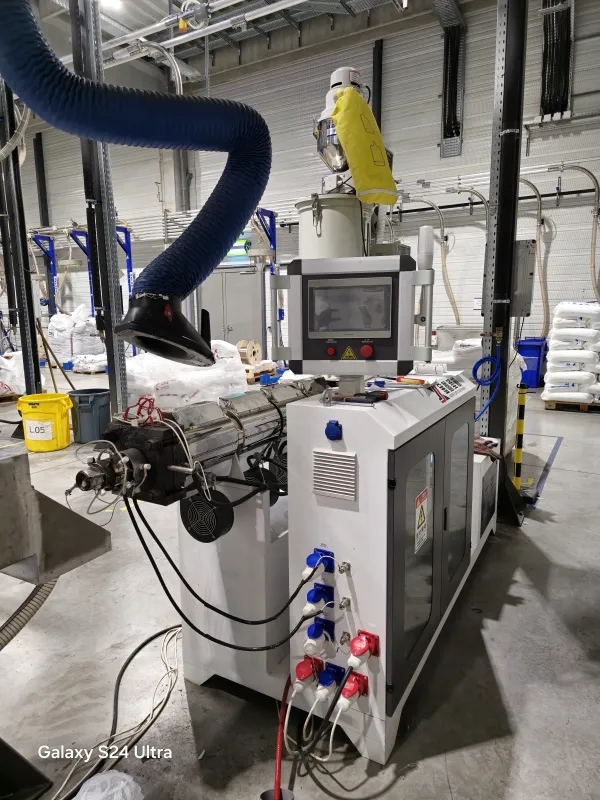
The extruder is the heart of any plastic extrusion line because it performs the core processing tasks: conveying, melting, mixing, and pressurizing. Without stable melt formation, nothing downstream can function properly.
But this component also needs a clear boundary. The extruder creates a processable melt. It does not, by itself, guarantee final dimensions, stable surface quality, haul-off coordination, or finished product delivery.
This is where many buyers oversimplify line evaluation. They compare screw diameter, motor power, or nominal output and assume they are comparing line capability. They are not. Two plastic extrusion lines with very similar extruders can perform very differently depending on die balance, cooling consistency, haul-off synchronization, and overall system matching.
The extruder is central, but not sufficient. For machine-level structure and internal working principles, see [→ What is extruder machine?].
3.4 Die and Tooling
The die shapes the pressurized melt into the target cross-section. Among all plastic extrusion line components, the die most directly determines how the product begins to take shape — but it should never be treated as just an attachment on the end of the extruder.
A die affects flow distribution, wall balance, section uniformity, and how difficult or easy it will be for downstream sections to produce a stable product. A well-designed die produces balanced, predictable melt flow across the section. A poorly matched or poorly balanced die pushes downstream sections into constant compensation — compensation that may reduce symptoms temporarily but rarely creates true stability.
A critical point: the shape at the die exit is not yet the final product dimension. The melt is still soft, still hot, and still subject to die swell, thermal shrinkage, and draw-down from the haul-off. Final dimensions are established jointly by the die geometry, the cooling and calibration conditions, and the haul-off speed.
Many buyers think “the die makes the shape, so the die determines the result.” In reality, the die starts the shape. The plastic extrusion system finishes it. The process fundamentals behind shaping through a die are introduced in [→ What is plastic extrusion?].
3.5 Calibration and Cooling
When the melt exits the die, it has form — but it does not yet have stable geometry.
At that moment, the material is still deformable. It is responding to tension, gravity, vacuum, water contact, temperature gradients, and line speed. The calibration and cooling section is the plastic extrusion line component where the shape begins to become permanent.
For rigid pipe, this stage often determines outer diameter consistency, roundness, and wall stability over time. For profiles, it strongly affects shape retention, corner behavior, and dimensional repeatability. For appearance-sensitive products, it can determine whether minor upstream variation becomes visible scrap.
Cooling is not just a thermal step. It is a geometry-locking step. If cooling is uneven — one side of the product solidifies before the other — the result can be warpage, ovality, or internal stress that only appears after the product leaves the line. If cooling is too slow, the product stays deformable for longer, and any speed fluctuation or process drift has more time to affect the final shape.
In real production, many “mysterious” dimension problems are actually downstream stabilization problems rather than extruder problems.
3.6 Haul-off
The haul-off is one of the most commonly underestimated plastic extrusion line components.
People often describe it as the unit that simply “pulls the product forward.” That is incomplete. The haul-off is actively participating in the final geometry of the product. It sets line speed, influences draw-down, and directly affects how much material ends up in each meter of product.
If the haul-off is pulling faster than stable melt delivery supports, the product thins. If it is pulling too slowly, material accumulates and the section becomes heavier or harder to stabilize. A 2% fluctuation in haul-off speed can translate directly into a 2% change in wall thickness — which, for products with tight tolerances, may be the difference between in-spec and rejected.
That means haul-off speed is not only a throughput variable. It is a dimension-control variable. A buyer may ask about extruder capacity, but if the downstream speed relationship is not matched, the final product will still drift.
For the specific relationship between extruder output and haul-off speed in a plastic extrusion line, see [→ Extruder output haul-off synchronization].
3.7 Cutting, Winding, and Finishing
The line’s end section determines how the product leaves the plastic extrusion system and becomes commercially deliverable.
Depending on the product, this may mean fixed-length cutting, coiling, winding, stacking, inline printing or marking, or downstream handling for packaging.
This component is easy to underestimate because the product already “exists” by then. But the end-of-line format is not a small detail. It affects rhythm, layout, handling efficiency, and whether the product leaves the line in a usable, saleable condition.
If a plastic extrusion line can form the product but cannot discharge it consistently in the right form, the system is still incomplete from a buyer’s point of view.
3.8 Control and Synchronization
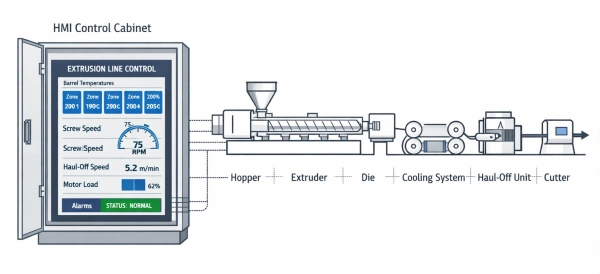
A real production line is not a row of unrelated machines. It is a coordinated plastic extrusion system in which feeding, melting, shaping, cooling, pulling, and finishing all operate around one common target: stable product output.
This is where line quality is often won or lost.
Two plastic extrusion lines may look similar on paper. They may use extruders of similar size, similar dies, similar cooling tanks, and similar pullers. Yet one line may run stably while the other requires constant intervention. In practice, the difference is often not the existence of individual components, but how well they are matched and how repeatably they stay coordinated over time. For a broader engineering perspective on how extrusion line integration affects process performance, see this overview of extrusion line systems.
This is why a plastic extrusion line should never be understood as “machine A plus machine B plus machine C.” It is a synchronized manufacturing system.
4. Why Different Products Need Different Plastic Extrusion Line Configurations
All plastic extrusion lines share the same manufacturing skeleton, but different products shift the system priorities and risk points. Understanding how a plastic extrusion line works means understanding that the same basic components serve very different functions depending on what the line is making.
Pipe Lines
Pipe extrusion lines place strong emphasis on sizing stability, cooling consistency, roundness, and wall thickness control. The buyer is not paying for “a round tube.” The buyer is paying for a pipe that can hold OD, wall thickness, and roundness within tolerance over long continuous runs. That means the plastic extrusion line must be evaluated not only by whether pipe comes out, but by whether the whole downstream stabilization system can hold quality over time.
Profile Lines
Profiles often expose matching problems more aggressively than simple round sections. Complex cross-sections increase sensitivity to flow balance, cooling behavior, pulling coordination, and asymmetrical shrinkage or distortion. A profile plastic extrusion line may look like “the same extruder with a different die,” but in practice, complex sections make system mismatch much easier to see.
Transparent Rigid Tube and Appearance-Sensitive Products
These products raise the sensitivity level of the entire plastic extrusion system further. Moisture becomes visible bubbles. Minor contamination becomes visible specks. Cooling inconsistency becomes haze, optical distortion, or surface instability. Process variation that might still be tolerated in opaque utility products often becomes direct scrap in transparent or appearance-sensitive products.
Product Differences Change the Real Line Focus
This is something we see very clearly in project discussions. Even when two customers are both making rigid products, the actual plastic extrusion line configuration priorities can be very different. A standard utility pipe, a complex profile, and a transparent rigid tube do not place the same demands on pre-treatment, downstream cooling, appearance control, or synchronization. Treating them as if they need the same line logic usually creates problems later.
That is why “same material family” or “similar output target” does not mean “same line emphasis.”
5. What Makes a Plastic Extrusion System Work Well
Having the right plastic extrusion line components on the floor is necessary, but it is not enough. What makes a plastic extrusion system work well is whether each section can perform its role stably and in coordination with the others.
Feed consistency matters because unstable input forces every downstream component into reactive compensation.
Melt consistency matters because the plastic extrusion line needs not only melt formation, but repeatable melt behavior over time. A melt that is “good enough” for the first ten minutes but gradually shifts in viscosity or temperature will produce a product that gradually drifts out of tolerance.
Die-to-downstream match matters because many quality problems are caused not by one section being “wrong” in isolation, but by two sections being poorly matched to the same product target. A die designed for one output rate and line speed may produce poor results when the plastic extrusion system is pushed to a different operating point — not because the die failed, but because the balance shifted.
Cooling consistency matters because uneven stabilization often amplifies small upstream variation into visible defects. A small pressure fluctuation in the extruder, barely noticeable in the melt stream, can become a measurable wall thickness variation after passing through a cooling section that solidifies one side of the product faster than the other.
Haul-off synchronization matters because line speed directly affects geometry, not just transport.
Repeatability over time matters because a plastic extrusion line that looks good for a short trial is not yet proven as a production system. The gap between “sample approved” and “production stable” is where most commercial production problems originate.
A plastic extrusion line works well only when feeding, melt delivery, shaping, cooling, and pulling remain matched closely enough to hold stable product geometry over time.

Many visible defects are only the surface result of deeper mismatch. By the time the operator sees wall drift, ovality, or surface instability, the real imbalance may have started much earlier in the plastic extrusion system.

6. Extrusion Line vs Extruder Machine: The Short Buyer Answer
Here is the direct answer buyers searching extrusion line vs extruder actually need.
A plastic extruder machine is the core processing unit. It melts, mixes, and pressurizes the material.
A plastic extrusion line is the complete production system built around that machine. It includes all upstream and downstream plastic extrusion line components required to turn raw material into a finished product continuously, within tolerance, and in the right delivery form.
You buy a machine to process plastic.
You buy a line to manufacture products.
That is the real difference between extrusion line vs extruder.
For a more detailed look at the machine itself, see [→ What is plastic extruder].
7. Before Discussing a Plastic Extrusion Line, Clarify These 5 Things
A productive plastic extrusion line discussion should not start with a machine model. It should start with the project conditions.
1. What exactly are you making?
Product type, section shape, dimensions, tolerances, surface requirements, and delivery format all affect how a plastic extrusion line should be configured. Until the product is clearly defined, the line cannot be properly defined. A line optimized for 110mm SDR11 water pipe is a fundamentally different configuration challenge than a line for a multi-cavity window profile, even though both may use a similar-sized extruder.
2. What material are you processing, and in what form?
Material type, pellet or powder, moisture sensitivity, recycled content, appearance requirements, and additive needs all influence feeding, pre-treatment, extruder behavior, die design, and downstream risk. A material that requires aggressive drying before processing changes the plastic extrusion line layout and operating discipline from the start. For the material side of this, see [→ Common Plastics Used in Extrusion].
3. What does output really mean in your case?
Output is not just kg/h. It must be understood together with line speed, product size, and quality conditions. A plastic extrusion system may have a theoretical peak, but the real question is what output can be held while maintaining quality. Peak output and stable output are different numbers — and stable output is the one that determines real productivity.
4. What quality issue matters most to you?
Is the biggest concern wall thickness, OD drift, surface marks, transparency, dimensional repeatability, or scrap rate? The answer changes which plastic extrusion line components deserve the most attention. Understanding the most critical quality requirement helps focus the line configuration where it matters most. Product-level symptom logic links forward to [→ Dowdstream machines].
5. How should the product leave the line?
Cut lengths, coils, inline printing, downstream handling, and packaging rhythm are not minor afterthoughts. They influence plastic extrusion line layout, finishing equipment, and production rhythm from the start.
Jinxin Project Perspective
In real line discussions, this is the order we use: product first, then material, then quality target, then output range, and only after that line arrangement and machine configuration. Starting from machine model or price too early usually causes rework later, because the plastic extrusion line cannot be judged correctly until the product requirement is clear.
The more complete the product information is at the beginning, the more accurate the line recommendation becomes.
The Most Common Buyer Mistake
Many buyers open the conversation by asking about extruder model, output capacity, motor power, and price. These are valid questions, but they belong later. In real projects, what actually determines whether a plastic extrusion line is suitable is the product drawing, the material condition, the quality target, and the delivery requirement. When those are defined first, the plastic extrusion system discussion becomes specific, efficient, and much less likely to require revision.
8. Conclusion: A Plastic Extrusion Line Is a Manufacturing System, Not a Single Machine
So, what is plastic extrusion line?
It is not just an extruder.
It is not just a row of machines.
It is not just the ability to make a sample.
A plastic extrusion line is a coordinated manufacturing system that takes raw material from entry to finished product through feeding, melt processing, shaping, cooling, pulling, and finishing — all while maintaining stability, dimensional control, and repeatability.
Plastic extrusion explains the process.
A plastic extruder machine explains the core processing unit.
A plastic extrusion line explains how the full plastic extrusion system actually works.
If you want to understand a plastic extrusion line, do not look only at the extruder. If you want to compare two lines, do not compare only output numbers. Look at whether the whole system — every plastic extrusion line component from feeding to finishing — is matched to the product, the material, the quality target, and the delivery requirement.
That is what determines whether a line can produce not only once, but reliably.
For the process fundamentals, start with [→ What is plastic extrusion?].
For the machine-level explanation, continue to [→ What is plastic extruder?].
Have Technical Questions?
Our engineering team is ready to help with your extrusion process or machine configuration.
Jason Shen
Jason is the founder of Jinxin Extruder and a veteran engineer with over 20 years of hands-on experience in plastic machinery.
Starting his career on the shop floor, he mastered every technical detail—from electrical wiring to complex troubleshooting.
Today, he personally oversees final inspections, ensuring every machine is built with deep technical expertise and field-tested reliability.
Further Reading
Extrusion Line Quotation: What Is Included and What to Check Before You Buy
Comparing extrusion line quotations? Use this scope of supply checklist to see what is included, what is typically excluded, and…Extrusion Screen Changer & Melt Filtration: How to Reduce Contamination and Pressure Fluctuation
A practical guide to screen changers in plastic extrusion — how melt filtration controls contamination, why screen changes cause pressure…