Meter Weight Control System in Plastic Extrusion: How It Works & Why It Matters
In plastic extrusion, the weight of finished product per meter is one of the most direct measures of quality and material efficiency. A pipe or profile that runs too heavy wastes raw material on every meter produced. One that runs too light risks failing dimensional or pressure specifications — and the customer rejection that follows.
A meter weight control system addresses this by measuring how much material is being fed into the extruder in real time and automatically adjusting the extrusion line to maintain a consistent output. On rigid pipe and profile lines, this is not an optional feature for high-precision runs — it is standard practice on well-configured production equipment.
What Is a Meter Weight Control System?
A meter weight control system is a gravimetric control setup that monitors and regulates the feed rate of material into an extruder to maintain a target weight per unit length of finished product.
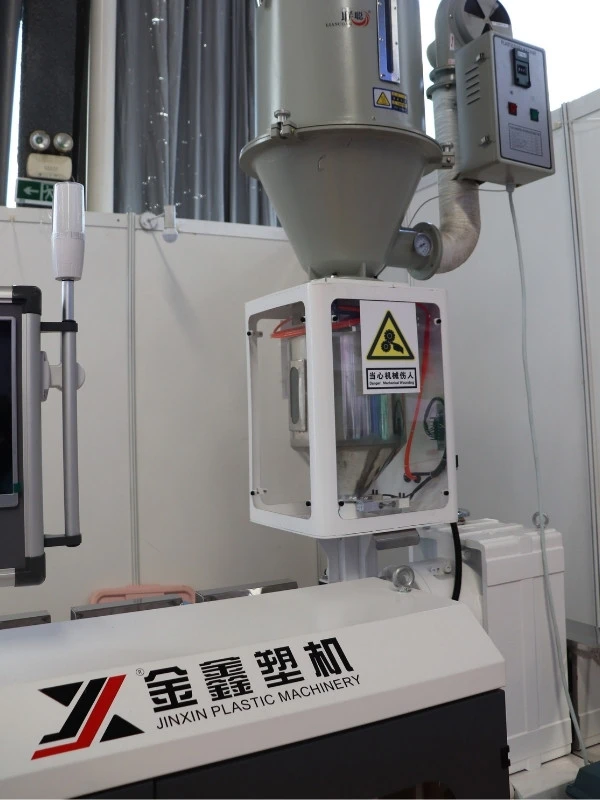
The most common implementation uses a loss-in-weight hopper: the entire material hopper is mounted on load cells (weighing sensors), and the system continuously measures the rate at which the hopper weight decreases. 1 This weight-loss rate directly reflects how much material is being fed into the extruder per unit of time. By comparing this to the line speed (measured at the haul-off), the system calculates the actual weight per meter being produced and adjusts the screw speed or haul-off speed to maintain the target value.

This approach requires a dedicated weighing hopper that is physically isolated from the extruder — any vibration or mechanical contact between the hopper and the machine frame would interfere with the weight measurement.
Core Components
A typical loss-in-weight meter weight control system includes:
- Weighing hopper with load cells — the hopper sits on precision load cells, isolated from the extruder frame, so the system can measure net material consumption in real time
- Haul-off speed encoder — measures the actual line speed, used to calculate meters produced per unit of time
- Control unit — compares actual weight per meter to the set target and issues correction commands
- Extruder speed interface — allows the controller to adjust screw RPM or haul-off speed automatically to maintain the target
The physical isolation of the hopper is critical. If the hopper is in contact with any vibrating part of the machine, the load cell readings become unreliable and the system cannot function accurately.
How It Works
The control loop operates continuously during production:
- Load cells measure the hopper weight at a defined sampling interval
- The system calculates the weight-loss rate (grams per second of material consumed)
- The haul-off encoder reports current line speed (meters per minute)
- The controller divides material consumption rate by line speed to calculate current weight per meter
- If the result deviates from the target, the controller adjusts screw speed, haul-off speed, or both to correct
- The loop repeats continuously, maintaining output within the specified tolerance band
This closed-loop approach means the system responds to real material behavior — including variation in bulk density, moisture content, and feed characteristics — rather than relying on preset screw speed parameters that assume consistent material properties.

Why It Matters
Material overuse adds up at scale. If a production run targets 500 g/m but the line is consistently producing at 520 g/m due to manual calibration drift, that 4% excess represents significant raw material cost across a full shift or production campaign. A meter weight system holds output to the target and prevents systematic overfeeding 2.
Manual adjustment cannot maintain tight tolerances across a full run. An operator can dial in weight per meter at the start of a run, but material temperature, screw wear, feed variation, and ambient conditions all shift throughout the day. Without automatic feedback, the process drifts. A gravimetric system corrects continuously.
Startup waste is a real cost on every production run. On manually controlled lines, operators spend time at the beginning of each run making incremental adjustments to stabilize output weight per meter — running off-spec material until the line is dialed in. A loss-in-weight system automatically targets the set value from the moment production begins, shortening this adjustment period and reducing the volume of off-spec material produced before the line reaches steady state. This is one of the primary reasons rigid pipe and profile manufacturers include this system as standard equipment.
Dimensional consistency is a customer specification, not a guideline. Pipe wall thickness and profile cross-section dimensions are specified tolerances, not targets. Consistent weight per meter is the upstream variable that controls both.
Real-World Impact
On production lines running with a meter weight control system:
- Weight per meter is maintained within a defined tolerance band throughout the run, not just at startup
- Material consumption is predictable — production teams can calculate actual material usage against planned output and identify process drift early
- Reduced startup waste — the system automatically ramps to the target weight per meter from the moment production begins, reducing the manual adjustment time and off-spec material that manual control requires
- Scrap rates from over- or under-spec product are reduced — the system catches deviations before they accumulate into a rejected batch
The magnitude of improvement depends on the baseline process and material type, but the primary value is consistency: the system holds the process to a defined standard across an entire production campaign.
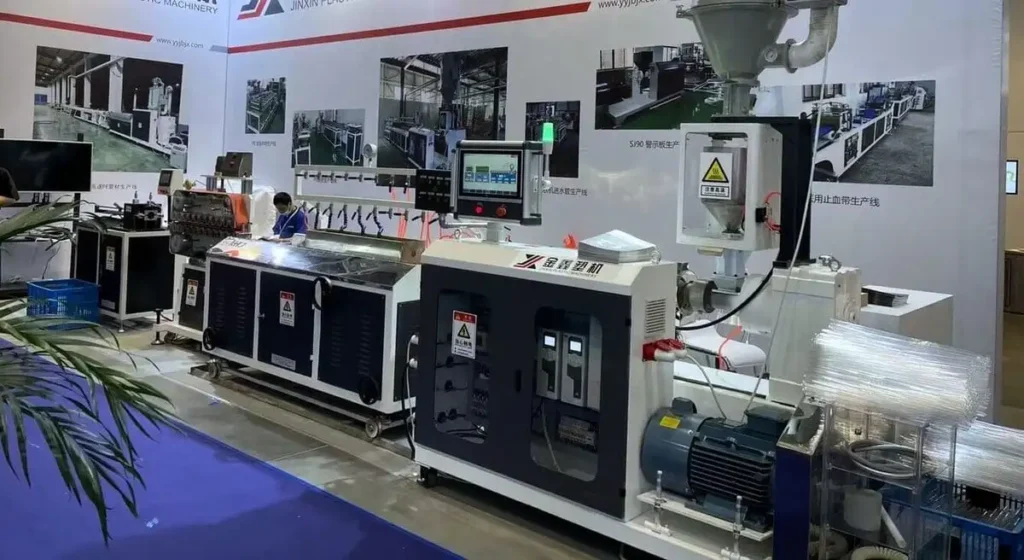
Applications
Rigid pipe and profile extrusion are the primary applications for meter weight control systems — and the reason Jinxin includes this as standard equipment on these lines.
In rigid pipe production (PVC, HDPE, PP, and similar materials), wall thickness tolerances are often specified within ±0.1 mm or tighter. Any variation in material feed rate translates directly into dimensional inconsistency, which can mean failed pressure tests, rejected batches, or costly rework. 3 A loss-in-weight system maintains a stable feed rate regardless of bulk density variation in the hopper, keeping output weight per meter within a consistent range throughout the run 4.
Profile extrusion faces the same challenge with added complexity: irregular cross-sections mean that small flow variations create visible surface defects or structural weak points. Maintaining a steady gravimetric feed rate gives the die a stable melt supply to work with.
Cable jacketing and other continuous extrusion applications can also benefit from meter weight control where dimensional tolerances are strict, though the system delivers the most measurable value on rigid structural products where wall thickness directly determines mechanical performance.
When Does a Meter Weight Control System Make Sense?
Not every extrusion line needs a loss-in-weight feeding system. The right question is not “should I add one?” — it is “what does the production environment actually require?”
A meter weight control system delivers clear value when:
- Dimensional tolerances are tight. If your pipe or profile spec requires wall thickness within ±0.1–0.2 mm, manual feed rate adjustment is difficult to sustain across a full shift. A gravimetric system removes the human variable.
- Material costs are high. Engineering resins, specialty compounds, and filled materials are expensive. Overfeeding — even slightly — adds up across a production run. A meter weight system lets you run closer to the minimum wall spec without risking under-spec product.
- Startup waste is a recurring cost. On manually controlled lines, operators spend time at the beginning of each run adjusting screw speed and haul-off to stabilize output. A loss-in-weight system automatically targets the set weight per meter from the start, shortening the adjustment period and reducing the amount of off-spec material produced before the line stabilizes.
- You are running long, consistent production campaigns. The system pays for itself faster when it is running the same product for extended periods, where small efficiency gains compound over time.
For lines running short trial runs, highly variable product mixes, or non-critical dimensional specs, the additional complexity may not be justified.
Conclusion
A meter weight control system solves a specific problem: keeping the weight of extruded product per meter stable, automatically, throughout a production run. On rigid pipe and profile lines — where wall thickness tolerances are tight, material costs are real, and startup waste on every shift adds up — this is not an advanced feature. It is the baseline for running a well-controlled process.
The loss-in-weight approach, with the hopper mounted on load cells and isolated from the extruder frame, is the industry-standard implementation. It measures what actually matters — how much material is being consumed — and uses that data to hold the process to spec.
References:
- Coperion K-Tron — Loss-in-Weight Feeder: How to Create Your Perfect Product
https://coperion.com/en/news-media/newsletter/2016/food-in-focus-edition-07/loss-in-weight-feeder-how-to-create-your-perfect-product - Coperion — Gravimetric & Volumetric Feeders
https://fhn.coperion.com/process/gravimetric-volumetric-feeders/ - DRTS — The Importance of a Gravimetric Feeder System in Extrusion
https://drts.com/the-importance-of-a-gravimetric-feeder-system-in-extrusion/ - ISO 161-1 — Thermoplastics Pipes: Nominal Outside Diameters and Nominal Pressures
https://www.iso.org/obp/ui/en/#!iso:std:65253:en
Have Technical Questions?
Our engineering team is ready to help with your extrusion process or machine configuration.
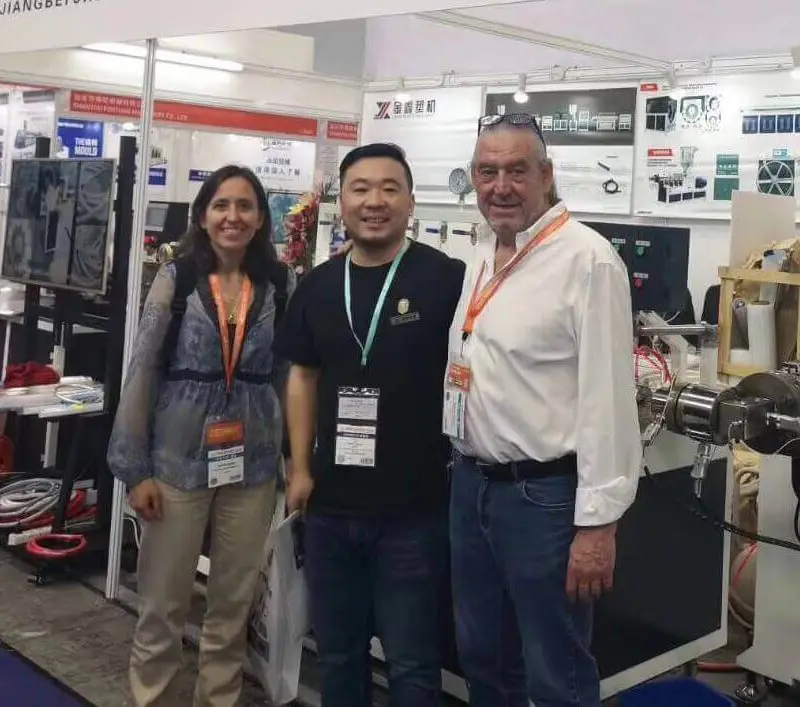
Jason Shen
Jason is the founder of Jinxin Extruder and a veteran engineer with over 20 years of hands-on experience in plastic machinery.
Starting his career on the shop floor, he mastered every technical detail—from electrical wiring to complex troubleshooting.
Today, he personally oversees final inspections, ensuring every machine is built with deep technical expertise and field-tested reliability.
Further Reading
Extrusion Line Quotation: What Is Included and What to Check Before You Buy
Comparing extrusion line quotations? Use this scope of supply checklist to see what is included, what is typically excluded, and…Extrusion Screen Changer & Melt Filtration: How to Reduce Contamination and Pressure Fluctuation
A practical guide to screen changers in plastic extrusion — how melt filtration controls contamination, why screen changes cause pressure…