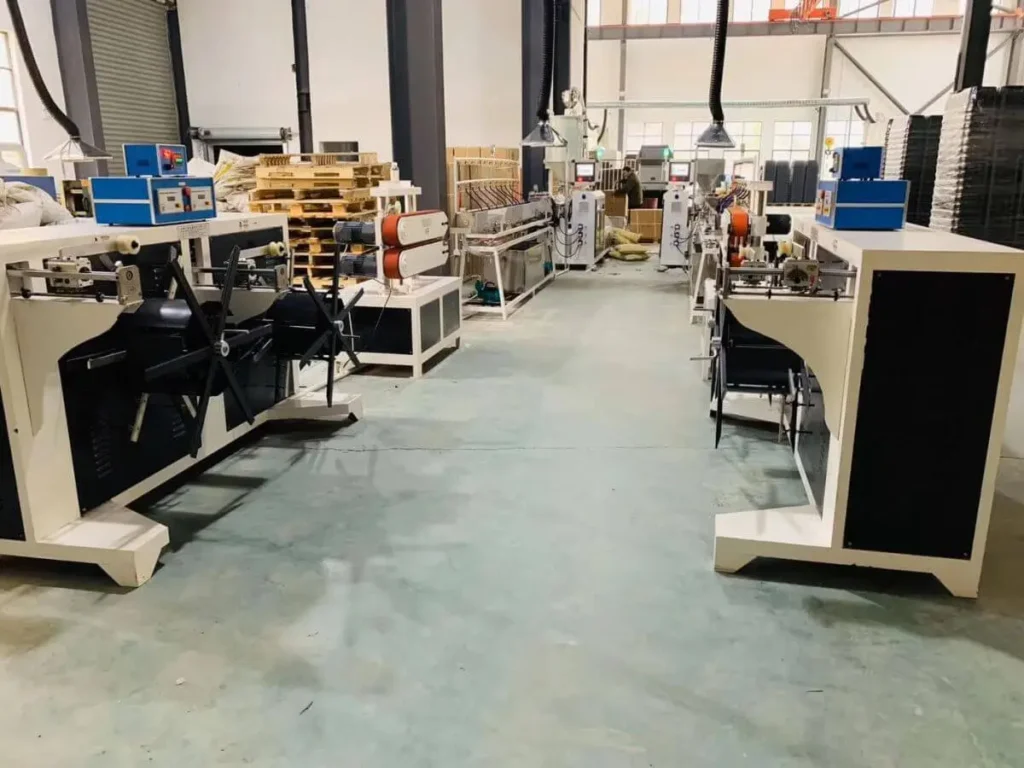
PPR Pipe Extrusion Line
High-speed single screw PPR pipe extrusion line for hot/cold water pipes (20–160mm) — also handles PE, HDPE, PP up to 250mm
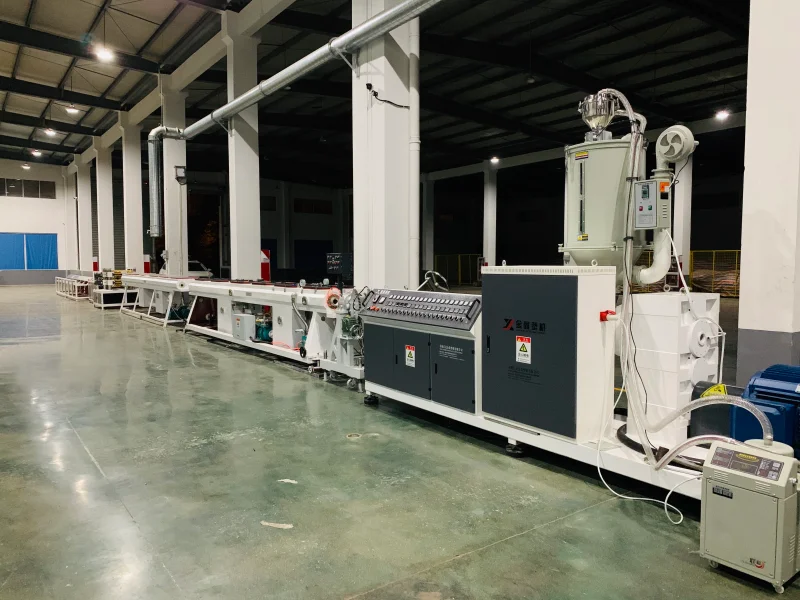
Custom-configured PPR pipe extrusion line designed for consistent wall thickness, dimensional accuracy to DIN 8077/ISO 15874, and reliable output across hot water, cold water, underfloor heating, and industrial chemical transport applications.
Some buyers may describe this system as a PPR pipe machine or PPR pipe extrusion machine, but Jinxin supplies the complete PPR pipe extrusion line: extruder, die, calibration, cooling, haul-off, cutting and stacking modules configured as one production system.
This PPR pipe extrusion line supports single-layer and 3-layer PPR-GF-PPR fiberglass reinforced configurations. The same extruder platform also functions as a plastic pipe extrusion line for PE, HDPE, PP pipes — with a die and calibration sleeve change plus parameter retuning, not a new machine.
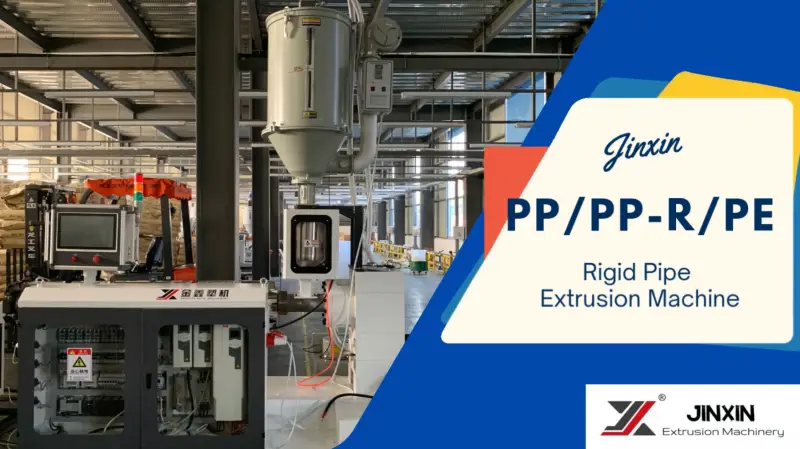
What Is a PPR Pipe Extrusion Line?
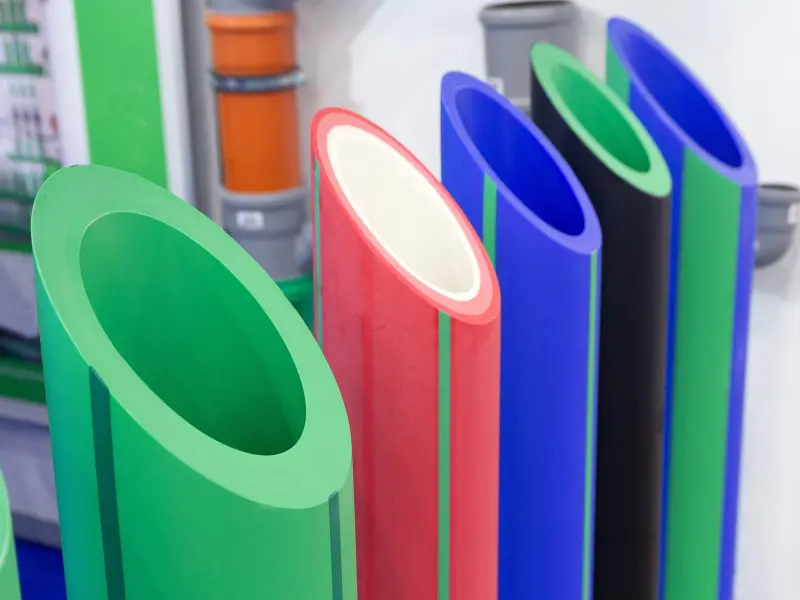
A PPR pipe extrusion line is a single-screw extrusion line that melts polypropylene random copolymer (PP-R) granules and forms them into continuous pipes for hot and cold water distribution, underfloor radiant heating, chilled water systems, and industrial chemical transport. These pipes are typically manufactured to DIN 8077/8078 or ISO 15874 standards.
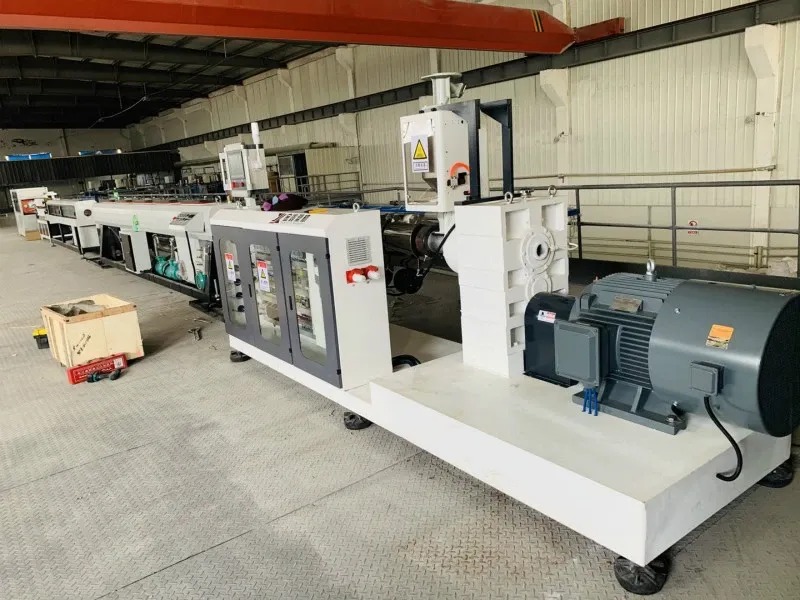


PPR Pipe Extrusion Line Technical Specifications & Model Selection
Core parameters for our SJ-Series PPR pipe extrusion lines. These configurations also process PE/PP/HDPE within the same diameter range. Custom configurations for higher output are available upon request.
|
Machine Configuration |
Screw Dia. |
L/D Ratio |
Pipe Range (mm) |
Max Output (kg/h) |
Specfication |
|---|---|---|---|---|---|
|
JX-SJ65/33 (Dual) |
65 mm |
33:1 |
20-75 (x2) |
200-250 |
Double Output Efficiency |
|
JX-SJ65/33 (Single) |
65 mm |
33:1 |
20-75 |
80-120 |
Standard Production |
|
JX-SJ75/33 (Single) |
75 mm |
33:1 |
50-160 |
80-150 |
Large Range Flexibility |
|
JX-SJ90/33 (Single) |
90 mm |
33:1 |
75-250 |
280-350 |
High Capacity for Big Sizes |
Complete PPR Pipe Production Line Modules
Dual-Strand Optional
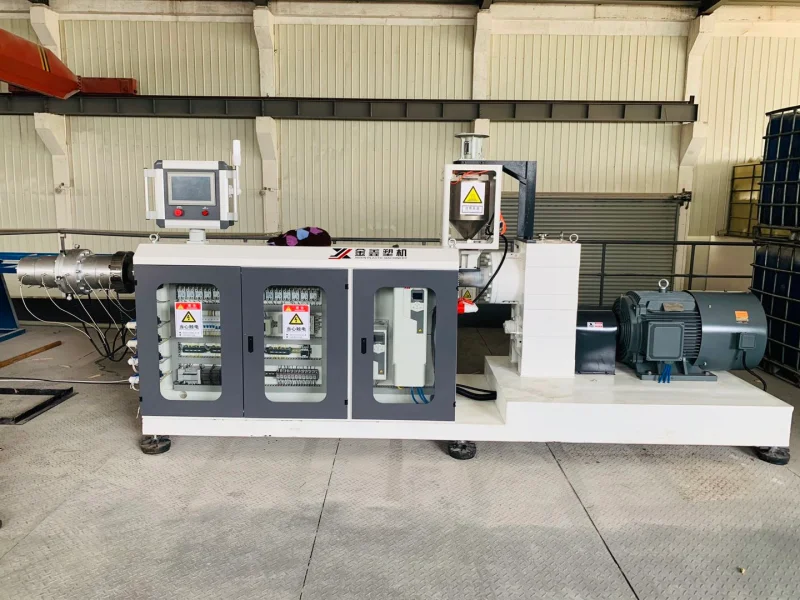
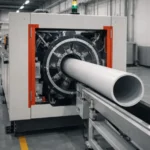
High-Efficiency Single Screw Extruder
- Motor: Siemens Beide inverter-duty motor
- Drive: Direct coupling design without belts
- Inverter: ABB ACS580 high-performance drive
- Control: WECON PLC and touch screen
- Screw: Nitrided steel screw for stable PP-R plasticizing
- Feeding: Weight-per-meter control can be included for material stability

Marking and Co-Extrusion
Auxiliary Co-Extruder
- Function: Supports color marking stripes or multi-layer pipe configuration
- Motor: Siemens Beide motor selected by project requirement
- Drive: Direct coupling for reliable power transmission
- Inverter: ABB ACS580 frequency control
- Adjustment: Independent mobility and position adjustment
- PPR-GF-PPR: Used with a multi-layer die when fiberglass-reinforced pipe is required
Precision Sizing
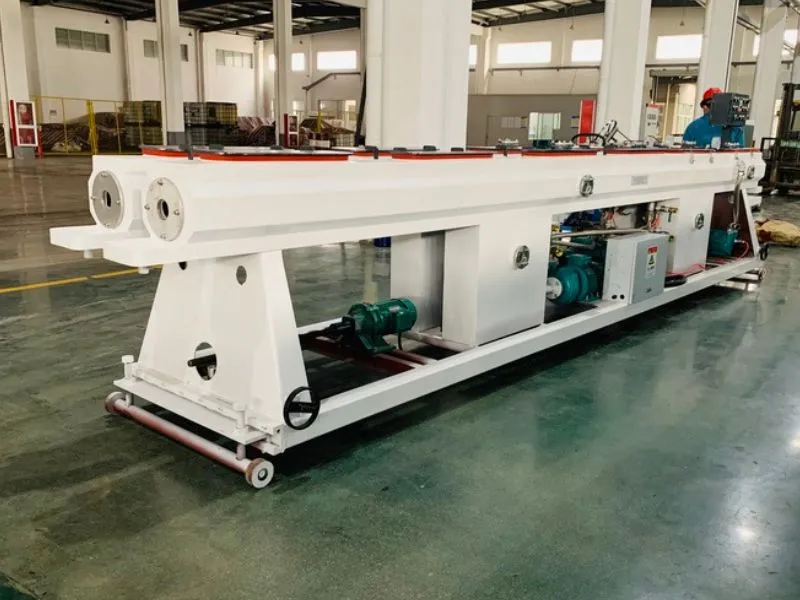
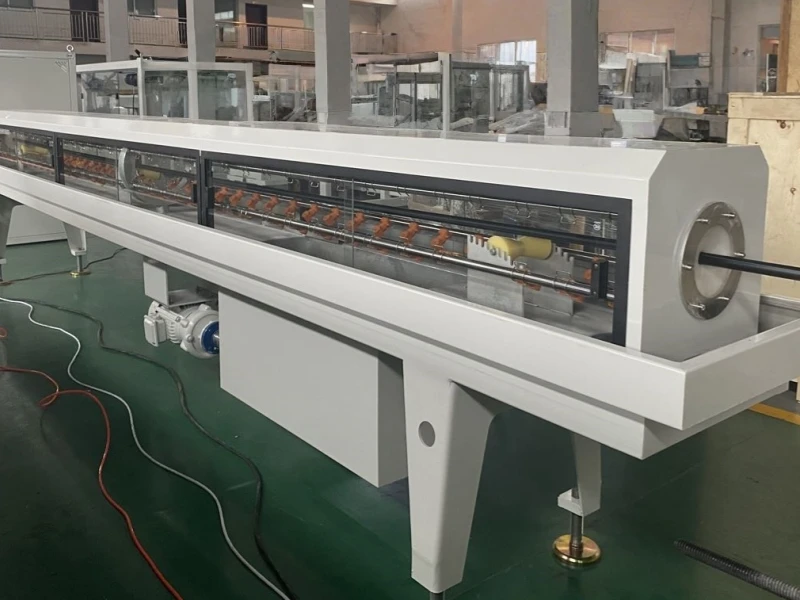
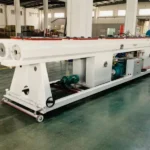
Vacuum Calibration Tank
- Material: SUS304 stainless steel tank body
- Cooling: High-pressure 360-degree spray system
- Control: Independent vacuum regulation for stable pipe sizing
- Alignment: 3-axis adjustment for precise centerline matching
- Stability: Automatic water level control
- Process Role: Helps maintain pipe OD, roundness and dimensional consistency
Rapid Cooling
Spray Cooling Tank
- Material: SUS304 stainless steel for corrosion resistance
- Cooling Method: 360-degree spray cooling for uniform pipe cooling
- Adjustment: Manual height, left and right alignment
- Drainage: Centralized drainage structure
- Pipe Stability: Cooling length is matched to pipe diameter and line speed
- Application: Supports stable sizing for hot and cold water PPR pipes

Dual-Motor Drive
Caterpillar Type Haul-Off
- Drive: Upper and lower independent motors for stable pulling
- Advantage: Reduced transmission backlash and smoother pipe movement
- Inverter: ABB frequency drive for speed control
- Blocks: Wear-resistant rubber blocks help avoid pipe surface damage
- Synchronization: Haul-off speed can be linked with the main HMI
- Output Control: Supports stable wall thickness and meter weight during production
Dust-Free Cutting
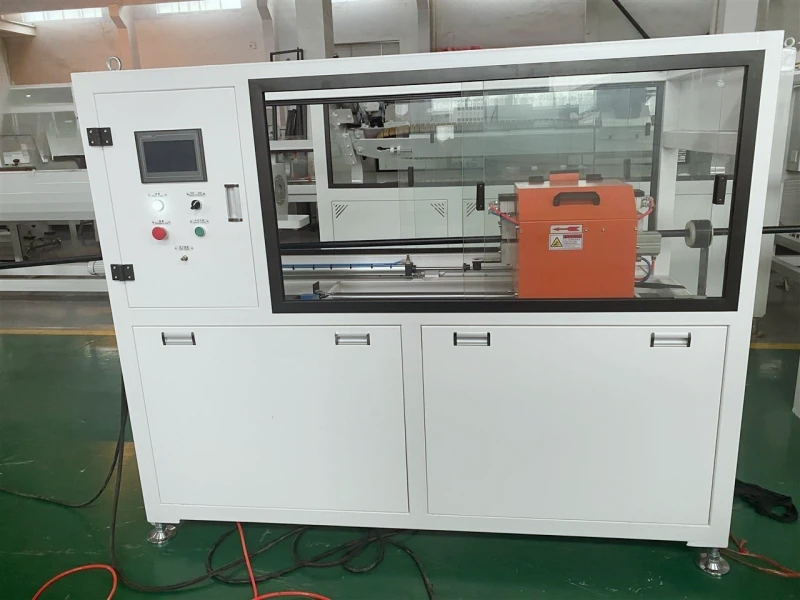
Chip-Free Cutter & 6m Stacker
- Cutting Method: Rotary chip-free cutting for cleaner pipe ends
- Control: PLC and touch screen operation
- Length Accuracy: Encoder length measurement for repeatable cutting
- Collection: 6m stacker can be included for standard pipe length handling
- Unloading: Pneumatic tipping supports smoother pipe collection
- Factory Use: Reduces dust and finishing work after cutting
Precision Tooling
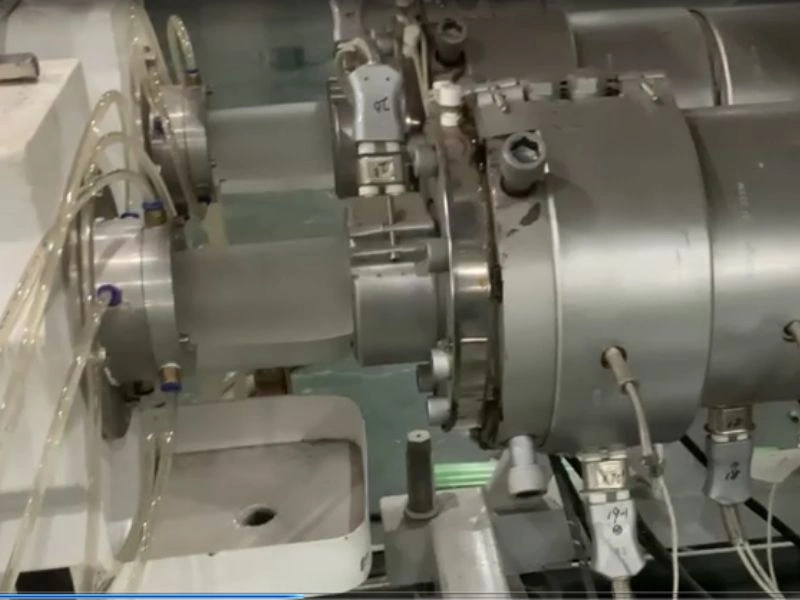
Spiral Die Head
- Structure: Spiral design helps distribute melt evenly around the pipe wall
- Material: Forged and polished 40Cr steel construction
- Connection: Aviation plugs support quicker heating connection
- Pipe Quality: Helps improve wall thickness uniformity
- Setup: Die and calibration sleeve are matched to the target pipe size
- PPR-GF-PPR: Multi-layer die tooling is configured when reinforced pipe is required
Recommended Auxiliary
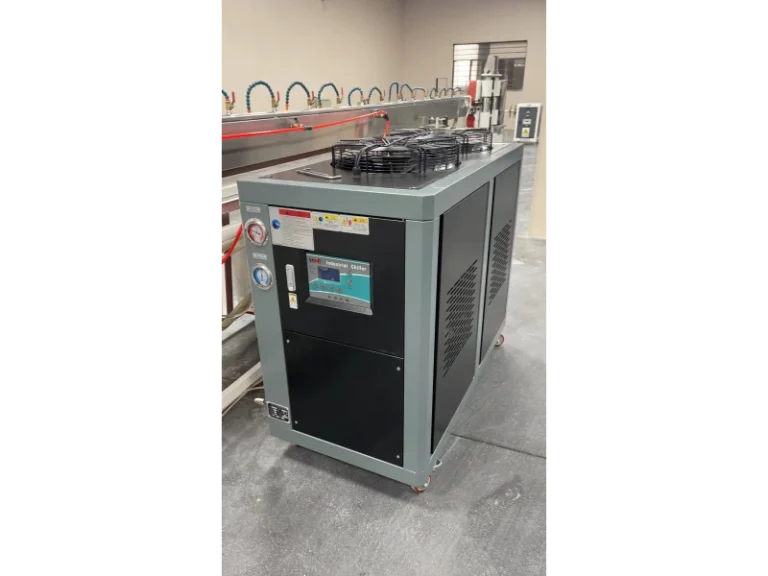
Air-Cooled Industrial Chiller
- Function: Provides closed-loop cooling water for the pipe line
- Advantage: Helps avoid dependence on a civil water pool
- Installation: Plug-and-play design for easier factory setup
- Temperature Control: Keeps cooling water more stable during continuous production
- Pipe Result: Stable water temperature helps maintain pipe size and surface quality
- Selection: Chiller capacity is matched to pipe size, output and local factory conditions
Ready to Configure Your PPR Pipe Extrusion Line?
Tell us your target pipe diameter, wall thickness standard (PN/SDR), material (PPR, PE, HDPE), and expected output. Our engineers will select the right extruder model and configure the complete line layout for you.
If you need a multi-layer PPR-GF-PPR setup, mention your fiberglass compound details so we can plan the co-extruder accordingly.
Use the contact panel on this page or email sales@jfextruder.com.
Applications — Where PPR Pipes Are Used
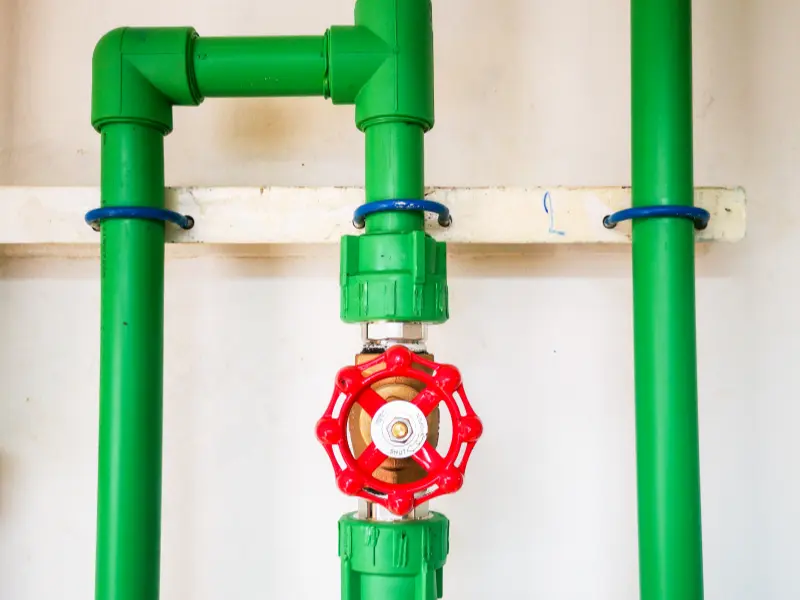
Water Distribution
Hot & Cold Water Plumbing
PPR is the dominant choice for residential and commercial water distribution in Europe, the Middle East, and Southeast Asia. Heat-fused joints eliminate leak points, and the material resists chlorine degradation and scale buildup.
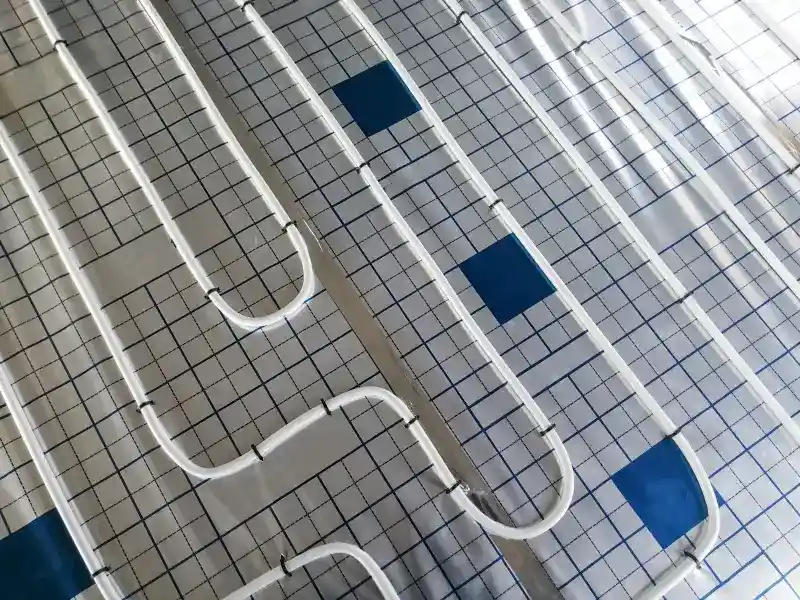
Heating Systems
Underfloor Radiant Heating
Underfloor systems demand dimensional stability under sustained temperature cycling. 3-layer PPR-GF-PPR fiberglass reinforced pipes are increasingly specified here for their lower thermal expansion coefficient.
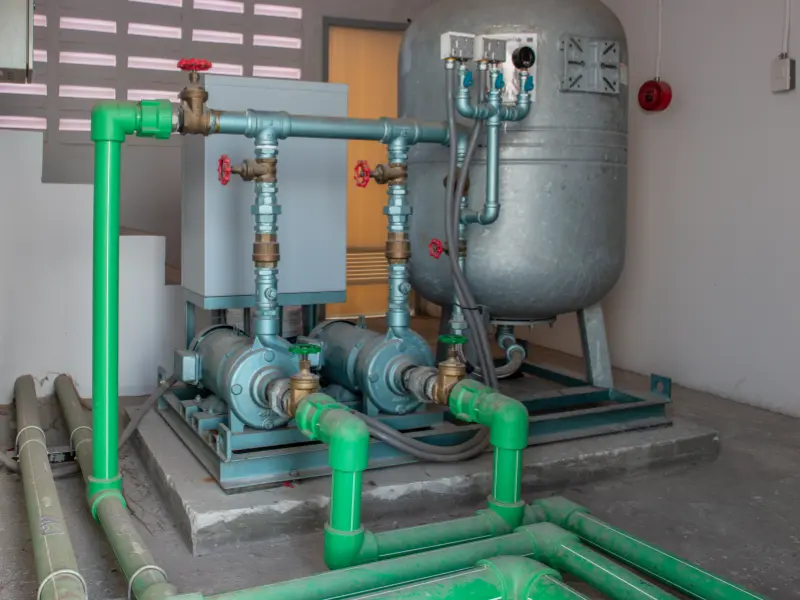
Commercial HVAC
Chilled Water & HVAC Systems
Commercial HVAC chilled water loops use PPR for corrosion resistance and smooth inner surfaces that minimize pressure loss. Larger diameters (75–160mm) are common in this segment.
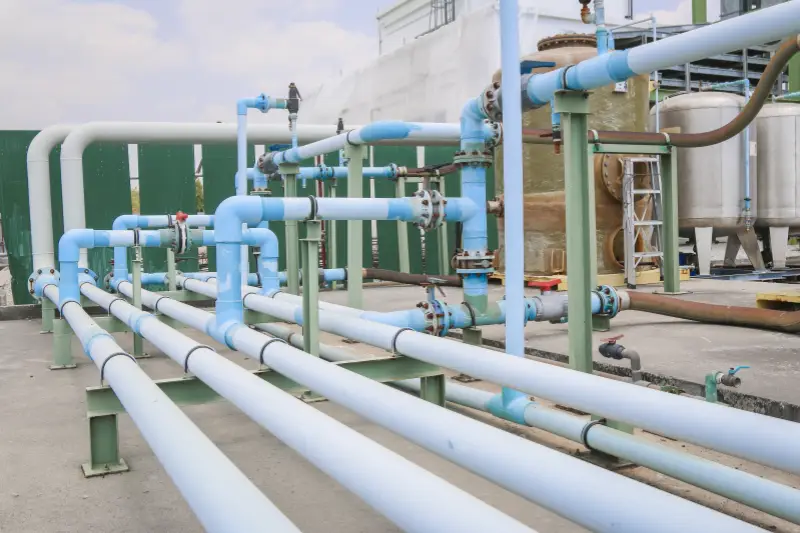
Industrial Fluid Lines
Industrial Chemical Transport
PP and PPR pipes serve chemical transport where metallic pipes would corrode. Material grade selection depends on the specific chemicals — we evaluate compatibility during the configuration phase.
Why Manufacturers & Procurement Leaders Choose Jinxin
Product-Based Factory Testing
Before shipment, we test-run the agreed product type to check die matching and stable product size under real extrusion conditions. After the product runs stably, we record practical startup references such as temperature zones, screw speed, haul-off speed and cutting or winding settings.
- Dimensional Verification: We run the line to prove the mold delivers your exact pipe dimensions and tolerances.
- The “Start-Up Recipe”: We record the successful processing parameters (temperatures, speeds) used during the trial. You receive this Data Sheet to skip the guesswork and start production immediately.
- Material Calibration: If your product uses a special compound, we may recommend sending material samples before testing so the startup references are based on the intended material.
Transparent, Line-by-Line Quoting
Your quotation isn’t a vague summary. It is a line-by-line manifest listing every equipment component and brand (e.g., Siemens, ABB), ensuring the hardware matches the promise.
- Detailed Configuration List: Every motor, inverter, tank, and controller is listed by brand and model.
- Clear Service Options: On-site installation and training are quoted as a distinct, transparent line item—no surprise fees later.
- The “Final” Price: No hidden add-ons. What you sign is what you pay.
Global-Service Component Strategy
We strictly implement a “Service-Ready” Component Strategy to ensure your supply chain security.
- Tier 1 Global Giants: For core drives and motors, we use Siemens, ABB, RKC and Omron—available in almost any industrial city worldwide.
- Proven International Brands: For controls and electrics, we select brands like WECON and CHINT, which have established distributor networks across major markets.
- Result: Whether it’s a premium drive or a standard relay, verified quality and convenient maintenance are guaranteed.
Trust Credentials
A majority of our international clients expand their capacity with us — an indicator of long-term reliability.
Our equipment is CE-certified for global market compliance. We also provide Certificate of Origin to help minimize your import duties.
What Our Clients Say
We were skeptical about buying from overseas, but the FAT video and parameter sheet they sent before shipment made commissioning straightforward. We hit target output on day three.
The dual-strand setup saved us from buying a second line. Their quote listed every component by brand, so there were no surprises.
We needed the PPR-GF three-layer configuration for a hot-water project. They calibrated the line with our material and delivered exactly what we needed.
FAQ — PPR Pipe Extrusion Line
Q1: What materials can this PPR pipe extrusion line process?
PP-R is the primary material. The same single screw extruder also processes PE, PP, and HDPE without changing the screw — only the die and calibration sleeve need to be swapped. 3-layer PPR-GF-PPR requires an auxiliary co-extruder and multi-layer die, available as add-on modules. This is why buyers searching for a PPR HDPE pipe extrusion machine often land on this platform — one extruder serves both resin families.
Q2: What pipe sizes and wall thickness tolerances can the line produce?
20–160mm OD for PPR, covering PN 10 through PN 20 per DIN 8077/8078. For 20–75mm, a dual-strand configuration runs two pipes simultaneously — roughly doubling output (250 kg/h vs 120 kg/h) without doubling floor space. Larger pipes (75–160mm+) run single-strand. Weight-per-meter control is integrated to prevent material over-use while maintaining target wall thickness.
Q3: Can this line produce multi-layer PPR-GF (fiberglass reinforced) pipes?
Yes. We add an auxiliary co-extruder and multi-layer die head to the base configuration — downstream equipment stays the same. PPR-GF-PPR’s fiberglass middle layer significantly reduces thermal expansion, making it preferred for underfloor heating and hot water recirculation. We configure the co-extruder specifically for the fiberglass-PP compound you plan to use.
Q4: How much does a PPR pipe extrusion line cost?
Approximate FOB China pricing for complete turnkey lines:
- Single-layer, single-strand (20–75mm): $35,000 – $45,000
- Dual-strand high-volume (20–75mm x2): $50,000 – $70,000
- Single-layer larger diameter (50–160mm): $35,000 – $55,000
- 3-layer PPR-GF-PPR fiberglass (20–160mm): $55,000 – $80,000
Includes: extruder, die, calibration, cooling, haul-off, cutter, stacker, Tier-1 electrics. Excludes: chiller, printer, freight, on-site installation.
Q5: Do we need to hire engineers for installation, or can our team handle it independently?
Both options:
- Independent setup: Modular design with aviation connectors, verified preset parameters, test videos, and full documentation.
- On-site support: Installation, commissioning, and operator training — costs itemized in the quotation, no hidden fees.
Q6: What spare parts should we keep in stock?
Every Jinxin pipe production line ships with a starter kit: heater bands ×2, die head heater sets ×2, solid-state relays ×5, cooling fan ×1, thermocouples ×2. Covers 12–18 months of normal operation. All core components (Siemens, ABB, Delta, Fotek, WECON) are global brands — long-term replacements are sourced locally, not from China.
Q7: How are PPR pipes made?
A PPR pipe extrusion line feeds PP-R granules into a single screw extruder, melts and plasticizes the material, forms the melt through a pipe die, sizes the pipe in vacuum calibration, cools it in spray tanks, pulls it with a synchronized haul-off, and cuts or stacks it to the required length. For PPR-GF-PPR pipes, an auxiliary co-extruder and multi-layer die add the fiberglass-reinforced middle layer during extrusion.
This is different from a PPR pipe welding machine or joining tool, which is used to connect finished pipes on site. Jinxin supplies the production line used to manufacture the pipe, not installation tools or finished PPR pipe products.
Q8: What is the difference between PPR and PVC pipes — and their extrusion machines?
PPR is heat-fused at joints, handles hot water up to 70°C continuous, and is extruded on a single screw machine. PVC is solvent-cemented, limited to cold water/drainage, and requires a twin screw extruder for powder processing.
The downstream equipment also differs — PPR needs longer cooling tanks and tighter calibration tolerances for pressure ratings. These are fundamentally different machines: a PPR line cannot process PVC, and vice versa.
Q9: How is a PPR pipe extrusion line different from a general plastic pipe extrusion line?
A PPR pipe extrusion line is a single screw line configured for PP-R melt behavior and DIN 8077/ISO 15874 dimensional standards.
Key differences versus a general-purpose line: PPR-specific compression ratio (33:1 L/D), spiral die heads for uniform wall thickness under pressure ratings, and controlled cooling for PPR’s crystallization behavior. A PVC drainage line uses a completely different screw type and cannot produce pressure-rated PPR pipe.
Q10: Is a PPR pipe machine the same as a PPR pipe extrusion line?
In procurement conversations, “PPR pipe machine” can refer to a complete extrusion production line — which is what this page covers. However, the term is also used for PPR pipe welding machines, fusion tools, pipe fitting equipment, or finished pipe supply. This page is specifically about the extrusion line that manufactures PPR pipes from raw PP-R granules: extruder, die head, calibration tank, cooling tank, haul-off, cutter and stacker.
Send Your PPR Pipe Line Requirements
Tell us your target pipe diameter, wall thickness standard (PN/SDR), and whether you need single-layer or 3-layer PPR-GF-PPR configuration. If you plan to process PE or HDPE on the same line, mention your full product range so we can configure the die and calibration accordingly.
Use the contact panel on this page or email sales@jfextruder.com.