After-Sales Support for Extrusion Lines: What to Expect

Extrusion line after-sales support is not just what happens when something breaks. It includes warranty coverage, spare parts planning, technical diagnosis, and the support process that helps resolve problems faster after delivery.
After an extrusion line arrives at your factory, the real test is no longer only machine design or commissioning quality. It is also whether your equipment supplier can help you diagnose faults clearly, provide replacement parts efficiently, and support your team when production problems appear.
This guide explains what extrusion line after-sales service actually looks like — what the warranty covers, what ships with the line, how the support process works when something goes wrong, and what you can do on your end to get issues resolved faster.
In this article, we cover:
- Warranty terms and boundaries
- Why component selection determines long-term serviceability
- What wear parts ship with the line
- How the support process works step by step
- What information accelerates diagnosis
- Preventive habits that reduce the need for support
What the Warranty Covers — and Where It Ends
Jinxin extrusion lines carry a 12-month warranty on the complete machine, starting from the date of delivery. The touch screen (HMI) carries an extended 18-month warranty, in line with common industry practice for operator interface panels that see heavy daily use.
During the warranty period, any component failure caused by non-human factors — manufacturing defects in core components such as the gearbox, screw, barrel, and motor — is covered. The replacement part is provided at no charge.
What the warranty does not cover:
- Consumable wear parts — heater bands, thermocouples, solid state relays, cooling fans, seals. These have a natural service life and are expected to need periodic replacement regardless of equipment quality.
- Damage from incorrect operation, improper installation, or operation outside specified parameters.
- Normal wear from standard production use.
Shipping costs for warranty replacement parts are typically borne by the client. However, in many cases, the original component manufacturer maintains local subsidiaries or authorized distributors in the client’s country. When applicable, replacement parts can be shipped through these local channels — significantly reducing delivery time compared to international shipment from China.
After the warranty expires
The warranty has a fixed duration. Support does not.
After the 12-month period, you can still contact us for technical guidance and parts procurement assistance. The only difference is that replacement parts are no longer free — the client covers the cost of parts and shipping. There is no service fee for the procurement assistance itself.
This is where the next section becomes directly relevant: the components inside your line determine whether “getting a replacement part” means a phone call to a local distributor — or weeks of waiting for an obscure part to ship internationally.
Why Component Selection Determines Long-Term Serviceability
One of the most consequential decisions a machine builder makes — and one that buyers rarely evaluate during the quotation stage — is which electrical and automation components go into the control cabinet and drive system.
Jinxin extrusion lines use components from internationally recognized manufacturers:
- Variable frequency drives: ABB ACS580 series — a high-performance industrial drive with global service and parts availability
- Motors: Siemens — established worldwide distribution and local service in most industrial markets
- Solid state relays: FOTEK — widely used in industrial automation, with straightforward sourcing globally
- Selected control components: Export-proven Chinese brands such as CHINT and WECON, chosen specifically for their overseas distribution networks and track records in exported industrial equipment
Why this matters after the sale:
These components follow standardized industrial specifications. They are not proprietary designs that lock you into a single supply chain. In most countries with an industrial automation market, you can source replacements through the manufacturer’s local subsidiary, an authorized distributor, or a general industrial supplier.
This is a deliberate design principle: the machine should remain serviceable anywhere in the world, by anyone with standard industrial electrical knowledge, without depending on the original builder for every replacement part.
You can verify component availability in your region directly. ABB, Siemens, FOTEK, and CHINT all publish their global office and distributor networks on their official websites.
What Ships with the Line: The Included Wear Parts Kit
Every Jinxin extrusion line ships with a practical wear parts package. These are consumable components with a finite service life under normal operation. Including them with delivery means that common replacement needs during initial operation do not require waiting for international parts sourcing.
Typical included items:
- Cast aluminum heater bands (barrel and die heating zones)
- Solid state relays (SSR)
- K-type thermocouples
- Cooling fans for heat dissipation
Scope clarification: This kit covers standard consumable wear parts. It is separate from the machine warranty, which covers manufacturing defects in core mechanical and electrical components. Including wear parts is a practical measure based on long-term operating feedback — not an indication of quality concerns.
The specific items and quantities are confirmed in the final commercial quotation, as they vary depending on extrusion line configuration.
For a detailed breakdown of wear parts coverage and low-maintenance design features, see our Spare Parts & Maintenance service page.
How Support Works When Something Goes Wrong
When a problem occurs on your extrusion line, the process is straightforward.
Step 1: Contact us and document the problem
Reach out through WhatsApp, email, or your established sales contact. The most important thing at this stage is visual documentation:
- Send a video showing the problem as it happens — this is by far the most effective diagnostic tool available
- Send photos of any visible damage, error messages on the HMI screen, or abnormal conditions
- Include a short description of when the problem started and what changed before it appeared
A 30-second video of the actual fault tells us more than a page of text. If the line is showing an alarm, record the alarm screen. If the product has a defect, film the product coming off the line. If a component is making unusual noise, record the sound.
Step 2: Diagnosis and solution
Based on your documentation, our engineering team diagnoses the issue. In our experience, we provide a confirmed diagnosis and clear action plan within one week — in straightforward cases, often within one to two days.
The solution typically falls into one of these categories:
- Parameter adjustment — the problem can be resolved by changing a setting, and we guide you through it
- Component replacement — a specific part needs replacing, and we identify the exact item and specification
- Further investigation — if documentation is not yet conclusive, we may ask for a specific test or additional video
Step 3: Parts procurement and delivery
If a replacement part is needed:
- Within warranty: We ship the replacement at no charge for the part. Client covers shipping.
- After warranty: We handle procurement — identifying the exact part, sourcing it, and arranging shipment. No service fee. Client pays only for the part and shipping.
For standard electrical components, local sourcing through the component manufacturer’s distribution network is often faster than international shipping and should be explored first.
A note on remote diagnostics
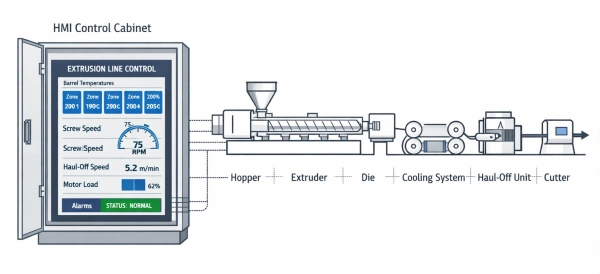
Our extrusion lines include hardware provisions for remote parameter access — the ability to view temperatures, speeds, and pressures remotely. The infrastructure is there.
However, remote parameter data alone has clear limits for real-world troubleshooting. You cannot see product quality, hear mechanical noise, or observe material behavior through a data dashboard. In practice, a clear video from the operator provides faster and more accurate diagnosis than remote parameter monitoring for the majority of real-world fault scenarios.
That is why we prioritize direct communication and visual documentation as the primary diagnostic path.
What Information Helps Resolve Issues Faster
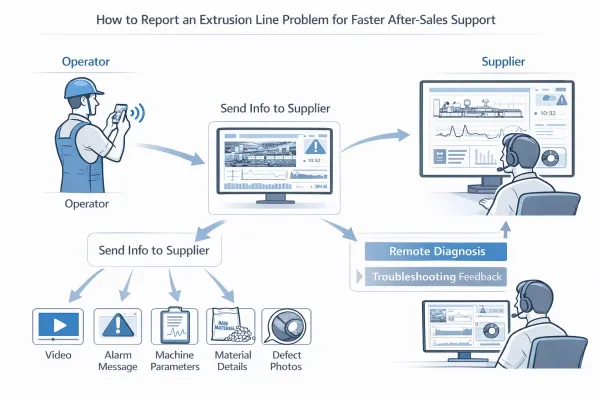
The speed of resolution depends largely on the quality of the initial report. Here is what makes the biggest difference:
Always send
- Video of the problem — the single most valuable diagnostic input
- Photos of visible damage or abnormal conditions
- HMI alarm screen or error messages — photograph or screenshot the display
Very helpful if available
- Current operating parameters — zone temperatures, screw speed, melt pressure, line speed as displayed on the controller
- FAT baseline parameters — every Jinxin extrusion line is tested at the factory before shipment, and the validated operating parameters are recorded and provided to the client. Comparing your current readings against these baseline values immediately narrows down where the deviation is occurring.
- Timeline — when the problem started, whether it is continuous or intermittent, and whether any change preceded it (material change, power event, ambient temperature shift)
Good practice
- Equipment serial number — helps us locate the exact configuration and component list for your specific line
- Recent maintenance actions — if you recently replaced a component or changed a setting, note it
The difference between a vague report and a focused one — video plus alarm log plus parameter comparison against FAT baseline — can mean the difference between a one-day resolution and a week of back-and-forth communication.
Reducing Downtime Before It Happens
The most effective after-sales support is the kind you never need to request. A few straightforward practices make a measurable difference in how often problems occur and how quickly they get resolved.
Follow a structured maintenance routine
A consistent maintenance checklist — daily, weekly, and monthly — catches problems while they are still minor. Most unplanned downtime traces back to something that was visible weeks before the actual failure: a thermocouple drifting out of range, a filter slowly clogging, a cooling circuit gradually losing efficiency.
When environmental conditions change — high ambient temperature, humidity, or dust load — adjusting your maintenance focus before symptoms appear is significantly cheaper than reactive troubleshooting after production is already affected.
Proper die care — cleaning, protection, and storage between runs — also prevents avoidable startup defects and repeated die lines that would otherwise trigger support requests. See extruder die maintenance best practices.
Use basic troubleshooting before calling
A quick structured check using a troubleshooting framework can sometimes identify an obvious cause — a tripped breaker, a disconnected sensor cable, a clogged filter. Even when the problem requires our support, the information gathered during basic diagnosis makes our response faster and more targeted.
Keep your FAT baseline data accessible
The factory acceptance test parameters provided at delivery are your reference point for the life of the machine. Store them where operators and maintenance staff can access them quickly. When something drifts, comparing current values to baseline is the fastest way to identify which system is changing.
Plan spare parts inventory proactively
If your operation depends on continuous production, consider stocking critical wear parts — particularly heater bands, solid state relays, and thermocouples. We provide free procurement assistance: you tell us what you need, we source it and ship it. You pay only for parts and freight.
Waiting until a component fails to begin sourcing it adds days of downtime that a small on-site inventory eliminates entirely.
Frequently Asked Questions
What is the warranty period for Jinxin extrusion lines?
The complete machine is covered by a 12-month warranty from the date of delivery. The touch screen (HMI) is covered for 18 months. During the warranty period, component failures due to non-human factors are covered with free replacement parts. Shipping costs for replacements are borne by the client.
Can I get support after the warranty expires?
Yes. Technical support and parts procurement assistance continue indefinitely. The only change is that replacement parts are no longer free — the client covers parts and shipping costs. There is no service fee for procurement assistance.
Can I source spare parts locally instead of ordering from China?
In many cases, yes. The electrical and automation components used in Jinxin extrusion lines — ABB drives, Siemens motors, FOTEK relays — follow standard industrial specifications and are available through manufacturer distribution networks in many countries. Local sourcing is often faster than international shipping.
What spare parts are included with delivery?
Each extrusion line ships with a wear parts kit that typically includes heater bands, solid state relays, thermocouples, and cooling fans. The specific items are confirmed in the commercial quotation, as they vary by line configuration. These are consumable items included for practical support, not an indication of quality concerns.
How long does it take to get a response when I report a problem?
We provide a confirmed diagnosis and action plan within one week of receiving adequate documentation — video, photos, and alarm information. For straightforward electrical or parameter-related issues, the turnaround is often significantly faster.
Do your extrusion lines have remote monitoring capability?
The hardware infrastructure for remote parameter access is built into the line. In practical troubleshooting, however, direct visual documentation — video and photos from the operator — provides faster and more actionable diagnostic information than remote dashboards for most real-world fault scenarios.
What is the most important thing to send when reporting a problem?
A video showing the problem as it happens. This single piece of documentation allows our engineering team to see exactly what is occurring — mechanical, thermal, product-related, or control-related — and diagnose the root cause far more accurately than a text description alone.
Need help with your extrusion line? Whether it is a warranty question, a technical issue, or a spare parts request — contact our team. We support every line we build, from commissioning through its full production life.
Have Technical Questions?
Our engineering team is ready to help with your extrusion process or machine configuration.
Jason Shen
Jason is the founder of Jinxin Extruder and a veteran engineer with over 20 years of hands-on experience in plastic machinery.
Starting his career on the shop floor, he mastered every technical detail—from electrical wiring to complex troubleshooting.
Today, he personally oversees final inspections, ensuring every machine is built with deep technical expertise and field-tested reliability.
Further Reading
Extrusion Line Quotation: What Is Included and What to Check Before You Buy
Comparing extrusion line quotations? Use this scope of supply checklist to see what is included, what is typically excluded, and…Extrusion Screen Changer & Melt Filtration: How to Reduce Contamination and Pressure Fluctuation
A practical guide to screen changers in plastic extrusion — how melt filtration controls contamination, why screen changes cause pressure…